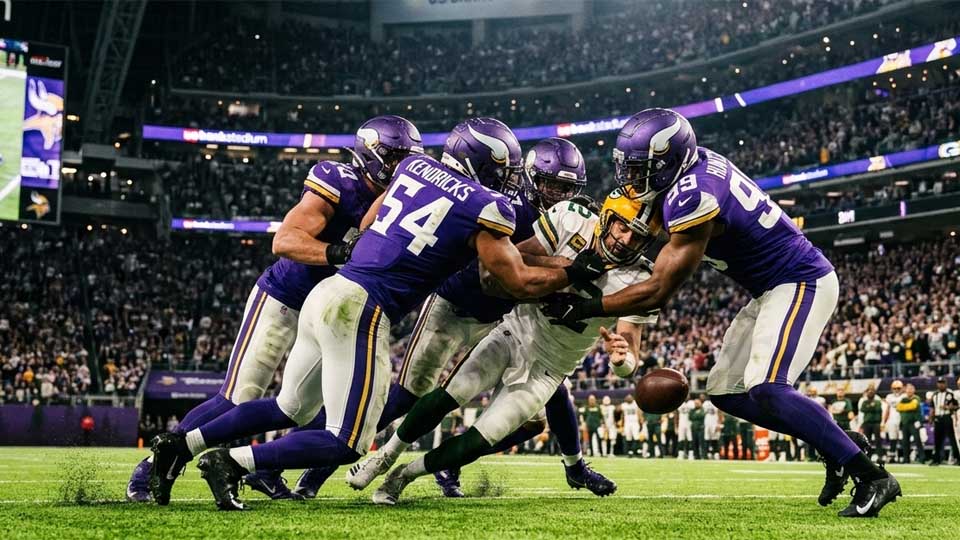
Using TriSync Sports to Find Defenses That Can Turn Pressure Into NFL DFS Points
Eight roster positions are filled.
You love your quarterback.
You found your running backs.
You built your receiver stack.
You found Value at tight end.
You finally get to:
D/ST.
You look at the salary you have left and say:
“Okay. Which defense can I afford?”
That's how a lot of DFS lineups are built.
And it's a mistake.
Defense/Special Teams is still:
A SCORING POSITION.
A sack scores points.
An interception scores points.
A fumble recovery scores points.
A safety scores points.
A blocked kick can score points.
A defensive or special-teams touchdown can completely change a tournament.
So instead of treating D/ST as:
WHATEVER FITS,
let's actually search for:
OPPORTUNITY.
Welcome to the:
TriSync Sports D/ST Pressure Strategy.
What Are We Looking For?
The basic idea is simple.
We want defenses capable of creating:
FANTASY EVENTS.
Not simply preventing yards.
Not simply being a good NFL defense.
We want events that generate DFS points.
That means we're interested in:
Sacks
Interceptions
Fumble recoveries
Safeties
Blocked kicks
Defensive touchdowns
and
Special-teams touchdowns.
What helps create many of those events?
PRESSURE.
Pressure Changes Everything
Imagine a quarterback drops back.
He has a clean pocket.
Plenty of time.
Receivers can finish their routes.
The quarterback can read the defense.
That's difficult for D/ST scoring.
Now imagine:
Immediate pressure.
The quarterback has to move.
The timing breaks down.
He throws early.
He gets hit.
Maybe:
SACK.
Maybe:
INTERCEPTION.
Maybe:
FUMBLE.
Maybe the ball gets tipped.
Maybe the defense scores.
Pressure creates:
CHAOS.
And chaos can create fantasy points.
We're Not Simply Looking for the Best Defense
This is important.
The NFL's best real-life defense isn't automatically:
THE BEST DFS D/ST.
Why?
Salary matters.
Opponent matters.
Turnover opportunity matters.
Sack opportunity matters.
Special teams matter.
Game environment matters.
A great defense facing an efficient offense may not offer the same DFS opportunity as a moderately priced defense facing:
A struggling quarterback.
A weak offensive line.
A turnover-prone offense.
Or an offense likely to be forced into obvious passing situations.
That's why we need:
CONTEXT.
Start With the TriSync Team Projections
TriSync gives us a powerful place to begin:
For D/ST, we can examine information such as:
D/ST Projection
Defense Projection
Special Teams Projection
Opposing Offense Projection
TriSync Value Projection
Points Min
Points Max
and
Salary.
Instead of asking:
“Which defense is cheapest?”
we can ask:
“Which defense offers the strongest combination of pressure opportunity, projection, ceiling and value?”
That's a much better question.
Start With the D/ST Projection
The overall:
D/ST PROJECTION
gives us the starting point.
How does TriSync view the unit's expected fantasy opportunity?
A strong D/ST Projection deserves attention.
But just like every other position:
ONE NUMBER DOESN'T MAKE THE DECISION.
Now we begin adding context.
Look at the Defense Projection
The:
DEFENSE PROJECTION
helps us evaluate the defensive side of the unit.
We're interested in players capable of creating:
Sacks.
Quarterback hits.
Interceptions.
Pass disruptions.
Tackles.
Turnover opportunities.
The stronger the defensive outlook, the more interesting the unit becomes.
Especially when facing a vulnerable offense.
Don't Forget Special Teams
It's called:
DEFENSE/SPECIAL TEAMS
for a reason.
Special teams can create scoring through:
Returns.
Blocked kicks.
And touchdowns.
These events aren't as predictable as basic offensive volume.
But they contribute to:
CEILING.
That's why the TriSync Special Teams Projection adds another useful layer.
We're evaluating the:
COMPLETE UNIT.
Now Look at the Opposing Offense
This may be one of the most important pieces.
Ask:
WHO IS THE DEFENSE FACING?
TriSync's:
OPPOSING OFFENSE PROJECTION
helps us evaluate the matchup from the other side.
A D/ST becomes especially interesting when:
Its own projection is strong.
And:
THE OPPOSING OFFENSE PROJECTION IS WEAK.
Now both sides of the matchup are beginning to point in the same direction.
Strong D/ST + Weak Offense
This is the combination we naturally want to investigate.
Suppose:
Team A has a strong D/ST Projection.
Its defensive players rate well.
Special teams are solid.
And Team B carries a weak offensive projection.
Now ask:
Can Team A create:
Sacks?
Turnovers?
Short fields?
A defensive touchdown?
This becomes a legitimate DFS opportunity.
Sacks Are the Foundation of Pressure
Let's begin with the most direct pressure statistic:
SACKS.
A sack provides fantasy points by itself.
But it can also create:
Long down-and-distance.
Punts.
Fumbles.
Desperate throws.
And additional pressure opportunities.
One sack can help create:
THE NEXT FANTASY EVENT.
That's why sack potential is so valuable.
Pressure Can Create Turnovers
Quarterbacks under pressure make different decisions.
They may:
Throw early.
Force the ball.
Lose control while being hit.
Fail to see a defender.
That creates opportunities for:
INTERCEPTIONS
and
FUMBLE RECOVERIES.
And turnovers can lead to even bigger events.
Turnovers Create Touchdown Opportunity
An interception is valuable.
But an interception returned for a touchdown?
That's a:
MASSIVE DFS EVENT.
Same with a fumble recovery.
Pressure near the opponent's goal line can create:
A short recovery.
A defensive touchdown.
Or excellent field position.
We can't reliably predict defensive touchdowns.
But we can search for environments where:
THE OPPORTUNITY FOR CHAOS IS HIGHER.
That's the goal.
Don't Chase Last Week's Defensive Touchdown
This is critical.
A D/ST scores:
22 FANTASY POINTS.
Everyone notices.
But maybe the defense had:
One sack.
One interception.
And two touchdowns.
Is that repeatable?
Probably not.
The touchdowns may have created the score.
But the underlying pressure wasn't particularly strong.
Don't chase:
YESTERDAY'S DEFENSIVE TOUCHDOWN.
Look for this week's opportunity.
Pressure Is More Repeatable Than Touchdowns
We can't expect a defense to score a touchdown every week.
But we can evaluate whether it has the ability to:
Pressure the quarterback.
Create sacks.
Disrupt passing lanes.
Force difficult decisions.
That's a better foundation.
Think:
PRESSURE FIRST.
Then allow the turnovers and touchdowns to create the ceiling.
Quarterback Matchup Matters
Some quarterbacks are more difficult to pressure.
They:
Release the football quickly.
Move well.
Avoid sacks.
Protect the football.
Others may:
Hold the ball longer.
Take sacks.
Force throws.
Struggle under pressure.
That's why the opposing quarterback is central to D/ST analysis.
We're not simply facing:
AN OFFENSE.
We're facing the player making most of the offense's decisions.
Offensive Line Matters
Pressure often begins with:
THE TRENCHES.
Can the offensive line protect the quarterback?
Are key linemen injured?
Does the defense have pass rushers capable of winning matchups?
A strong defensive front against a vulnerable offensive line can create:
REPEATED PRESSURE OPPORTUNITIES.
And repeated pressure gives us multiple chances for DFS scoring events.
Game Script Can Create More Pressure
Suppose the opposing offense falls behind:
24-7.
What happens?
They have to throw.
The defense knows it.
The pass rushers can attack.
The offense can't hide behind the running game.
Now we may get:
More drop-backs.
More sacks.
More quarterback hits.
More interception opportunities.
That's a very favorable D/ST script.
This Is Why Favorite D/STs Can Be Attractive
If a strong team takes control of the game, its defense may benefit.
The opposing offense becomes predictable.
Pass.
Pass.
Pass.
That creates:
PASS-RUSH OPPORTUNITY.
But don't blindly roster every favored defense.
We still need:
TriSync support.
Value.
Ceiling.
And the right salary.
A Low-Scoring Game Can Help
Suppose TriSync identifies a matchup where:
Both offenses project poorly.
Both defenses project strongly.
That may not be a game we want to attack with:
QB stacks.
WR ceiling plays.
Or Bring-Backs.
But it may be a great place to look for:
D/ST.
The environment itself can direct us toward the defensive side of DFS.
Points Allowed Still Matters
DraftKings D/ST scoring also rewards defenses for limiting points.
The scoring structure gives greater value to lower points allowed, while defenses allowing large point totals can eventually receive negative scoring.
That matters.
But:
POINTS ALLOWED SHOULDN'T BE THE ENTIRE STRATEGY.
A defense can allow some points and still produce useful DFS scoring through:
Sacks.
Turnovers.
And touchdowns.
We're looking for the complete scoring profile.
Pressure Can Offset Points Allowed
Imagine a defense allows:
24 POINTS.
Not ideal.
But it also produces:
Five sacks.
Two interceptions.
A fumble recovery.
And a defensive touchdown.
That's a completely different fantasy outcome from a defense allowing 24 points with:
Zero sacks.
Zero turnovers.
The scoreboard doesn't tell the entire DFS story.
That's why:
FANTASY EVENTS MATTER.
Now Bring in TriSync Value Projection
This is where D/ST gets especially interesting.
Defense is often a position where we can save salary.
But:
CHEAP DOESN'T AUTOMATICALLY MEAN VALUE.
The TriSync Value Projection helps us determine whether the lower-cost defense actually offers attractive DFS opportunity for its salary.
We're looking for:
PRESSURE AT THE RIGHT PRICE.
Don't Automatically Pay Up at D/ST
Suppose:
D/ST A
Salary: $3,500
Strong projection
Strong matchup
Large Points Max
D/ST B
Salary: $2,500
Comparable projection
Strong Value Projection
Large Points Max
If the cheaper unit gives us comparable upside?
That:
$1,000
can be extremely useful elsewhere.
Maybe it upgrades:
WR3.
TE.
FLEX.
Or RB2.
D/ST salary decisions affect the entire lineup.
Don't Automatically Punt D/ST Either
The reverse is also true.
Suppose the cheapest defense costs:
$2,200.
But TriSync shows:
Weak D/ST Projection.
Strong Opposing Offense Projection.
Low Points Max.
Poor matchup.
We're not saving money.
We're potentially buying:
A BAD ROSTER SPOT.
If another $500 creates a substantially better D/ST profile?
Spend it.
Value Is Different From Cheap
This principle runs through all of TriSync DFS.
CHEAP = SALARY.
VALUE = OPPORTUNITY RELATIVE TO SALARY.
Those are not the same thing.
At D/ST, this distinction is especially important because many DFS players simply choose:
THE CHEAPEST DEFENSE THEY CAN TOLERATE.
We want to do better.
Points Max Is Critical for GPPs
Defense is volatile.
That's not necessarily a problem in:
GPPs.
We want access to:
CEILING.
Look at:
POINTS MAX.
Suppose:
D/ST A
Salary: $3,500
Points Max: 14
D/ST B
Salary: $3,000
Points Max: 22
If D/ST B also has:
Strong Value Projection.
Useful defensive outlook.
Weak opposing offense.
That's extremely interesting.
One Defensive Touchdown Changes Everything
This is why Points Max matters.
A defense may produce:
Three sacks.
Two turnovers.
Then suddenly:
PICK SIX.
The fantasy score jumps.
Those high-end D/ST outcomes can become extremely valuable in tournaments because:
DEFENSE IS OFTEN UNDER-ANALYZED.
A big D/ST score can separate a lineup.
Points Min Matters Too
For cash games, we don't necessarily need the defense most likely to score:
25.
We may prefer a unit with:
Reasonable salary.
Strong projection.
Weak opposing offense.
Useful Points Min.
And a good chance to avoid:
NEGATIVE SCORING.
That's a different objective.
Cash D/ST Strategy
For cash contests, emphasize:
D/ST Projection
TriSync Value Projection
Points Min
Opposing Offense Projection
salary
and
reasonable pressure opportunity.
We're looking for:
STABILITY AT A SENSIBLE PRICE.
We don't need to make defense the hero of the lineup.
We simply don't want it to become:
THE PROBLEM.
GPP D/ST Strategy
For tournaments, increase the emphasis on:
Points Max
Sack potential
Turnover potential
Pressure
Special Teams upside
Salary leverage
and
contrarian opportunity.
We're searching for a defense capable of producing:
A DIFFERENCE-MAKING SCORE.
D/ST + RB Correlation
This is one of the most logical correlations in NFL DFS.
Suppose Team A's defense plays extremely well.
They create:
Turnovers.
Short fields.
Stops.
Team A takes the lead.
What may happen next?
THE OFFENSE RUNS THE BALL.
Now Team A's running back receives:
Additional carries.
Clock-killing opportunities.
Maybe goal-line work.
That's why:
RB + D/ST
can be a very logical pairing.
The Game Story Makes Sense
Imagine our lineup contains:
RB A + D/ST A.
What are we betting on?
Team A plays from ahead.
The defense pressures the opposing QB.
The opponent struggles.
Team A controls possession.
RB A receives volume.
D/ST A receives pass-rush opportunities.
Both can benefit from:
THE SAME GAME SCRIPT.
That's correlation.
D/ST + Game Environment Strategy
Not every attractive game environment is a shootout.
Remember our different game stories.
One may be:
ONE-SIDED CONTROL.
Strong offense.
Strong defense.
Weak opponent.
That may point toward:
RB + D/ST.
Another game may be:
DEFENSIVE STRUGGLE.
Now one or both D/ST units may become interesting.
Game Environment Strategy helps us identify:
WHERE DEFENSIVE PRODUCTION MAY GATHER.
D/ST + Contrarian Leverage
This can be extremely powerful.
Defense is volatile.
That means popular D/ST selections can fail.
Suppose everyone uses:
D/ST A.
TriSync identifies:
D/ST B
with:
Comparable Value Projection.
Larger Points Max.
Strong Defense Projection.
Weak Opposing Offense Projection.
And a lower salary.
Now D/ST B may create:
LEVERAGE.
If B scores 16 and A scores 4?
That's:
12 POINTS
against a large portion of the field.
D/ST Can Be the Easiest Place to Get Different
You may love:
Your QB.
Your RBs.
Your WR stack.
Your TE.
Your FLEX.
You don't need to destroy the lineup just to become different.
Maybe the leverage comes from:
D/ST.
One roster change can create meaningful differentiation.
Especially in large GPPs.
But Don't Be Contrarian Just to Be Contrarian
Suppose the low-owned defense is facing:
An elite offense.
An elite quarterback.
A strong offensive line.
And TriSync gives the defense:
Weak Value Projection.
Low Points Max.
Why are we using it?
Because nobody else is?
That's not strategy.
That's hope.
We still need:
A TRISYNC REASON.
Direct Leverage Against a Popular Offense
Here's where D/ST becomes particularly interesting.
Suppose the field loves:
QB A + WR A.
But TriSync identifies the opposing defense with:
Strong D/ST Projection.
Strong Value Projection.
Large Points Max.
And the offense itself doesn't project as strongly as the public assumes.
Now the defense can become:
DIRECT LEVERAGE.
If D/ST succeeds?
The popular stack probably struggles.
We gain points from our defense while many competing lineups lose production from their offense.
That's powerful.
This Is True Leverage
Suppose:
30% of the field uses QB A.
25% uses WR A.
Maybe many use both.
You use:
D/ST B.
If D/ST B produces:
Five sacks.
Two interceptions.
A fumble.
And a touchdown?
You aren't simply scoring D/ST points.
You're benefiting from:
THE FAILURE OF A POPULAR OFFENSE.
That's one of the strongest forms of leverage available.
But Make Sure the Numbers Support It
Don't attack a popular offense merely because:
IT'S POPULAR.
Check:
D/ST Projection.
Defense Projection.
Special Teams Projection.
Opposing Offense Projection.
TriSync Value Projection.
Points Max.
Salary.
If the complete profile supports the defense?
Now we have a legitimate tournament idea.
D/ST + Chalk + Leverage
Maybe the popular defense is actually excellent.
TriSync agrees.
Use it.
Remember:
GOOD CHALK IS STILL GOOD.
We can create leverage at:
QB.
WR.
TE.
Bring-Back.
Or salary construction.
We don't need every position to be different.
D/ST + Marquee & Marginal
Defense can also help fund our Marquee players.
Suppose TriSync identifies a:
$2,700 D/ST
with:
Strong Value Projection.
Good matchup.
Large Points Max.
That lower-cost defense may help us afford:
An elite RB.
Marquee WR.
Or premium stack.
The defense isn't merely filling the final roster spot.
It's:
FINANCING THE LINEUP.
But Marginal Salary Doesn't Mean Bad Defense
This fits our Marquee & Marginal philosophy perfectly.
We're spending:
MARGINAL SALARY.
But we still want:
QUALITY OPPORTUNITY.
The defense should have a reason to succeed.
Pressure.
Matchup.
Value.
Ceiling.
Weak opposing offense.
Don't confuse:
CHEAP
with:
USEFUL.
D/ST + Late Swap
If your D/ST plays in a later game, it may become part of Late Swap Strategy.
Suppose your early players smash.
Maybe you prefer:
A stronger Points Min.
A safer matchup.
A more dependable defense.
Now suppose your early lineup struggles.
Maybe we need:
A LARGER POINTS MAX.
A more volatile D/ST with strong pressure and turnover potential may become more attractive.
Again:
WHAT DOES THE LINEUP NEED NOW?
Special Teams Can Create Hidden Ceiling
Don't overlook:
SPECIAL TEAMS.
A return touchdown can completely change the D/ST result.
So can:
A blocked punt.
Blocked field goal.
Or other special-teams scoring events.
These aren't easy to predict.
But the TriSync Special Teams Projection gives us another piece of information when comparing units.
If two defenses look similar?
A stronger Special Teams outlook can become:
A USEFUL TIEBREAKER.
Defensive Stars Can Matter
TriSync also evaluates individual defensive players.
That gives us another layer.
If several important defenders are in:
Strong Performance Windows.
And the unit's overall D/ST outlook is attractive?
That may strengthen the case.
Remember:
The team projection is built from:
THE PLAYERS WHO CREATE THE RESULTS.
Pass Rushers Deserve Attention
For this strategy in particular, we're interested in defensive players capable of creating:
PRESSURE.
Edge rushers.
Defensive linemen.
Blitzing linebackers.
Players producing:
Sacks.
QB hits.
Pass disruptions.
A strong collection of individual defensive projections can support the broader D/ST outlook.
Defensive Backs Finish the Opportunity
Pressure may force the bad throw.
But someone still has to:
INTERCEPT IT.
Strong secondary play can turn quarterback pressure into:
Turnovers.
Pass breakups.
And defensive touchdowns.
The best pressure environments often involve:
FRONT AND BACK WORKING TOGETHER.
Pressure forces the mistake.
Coverage punishes it.
A Hypothetical D/ST Comparison
Imagine three defenses:
D/ST A
Salary: $3,900
D/ST Projection: 6.2
TriSync Value Projection: 2.60
Points Min: 5
Points Max: 18
Opposing Offense Projection: Strong
D/ST B
Salary: $3,100
D/ST Projection: 6.0
TriSync Value Projection: 3.25
Points Min: 6
Points Max: 23
Opposing Offense Projection: Weak
D/ST C
Salary: $2,300
D/ST Projection: 3.9
TriSync Value Projection: 2.20
Points Min: 1
Points Max: 13
Opposing Offense Projection: Strong
Which is the most expensive?
D/ST A.
Which is the cheapest?
D/ST C.
But which has the most interesting complete DFS profile?
Very possibly:
D/ST B.
It offers:
Comparable overall Projection to A.
Stronger Value.
Higher Points Min.
Larger Points Max.
A weaker opposing offense.
And:
$800 IN SALARY SAVINGS.
That's what D/ST Pressure Strategy is trying to uncover.
Don't Always Choose D/ST Last
This may be the biggest practical change.
You don't necessarily need to choose defense:
FIRST.
But don't wait until every other position is locked and then say:
“I have $2,400 left. Who fits?”
Include D/ST in the construction process.
Maybe spending:
$400 more
at defense gives us a much stronger opportunity.
Maybe spending:
$700 less
barely changes our D/ST outlook and upgrades WR.
We need to compare:
COMPLETE LINEUPS.
D/ST Salary Is Part of the Puzzle
Suppose:
Lineup A uses a $3,700 defense.
Lineup B uses a $2,800 defense.
The cheaper defense has:
Comparable Value.
Similar Points Max.
Better opposing offense matchup.
Now the $900 savings upgrades:
WR3 from Filler
to:
VALUE+.
Which lineup is better?
That's the question.
Don't evaluate D/ST salary in isolation.
Pressure + Vulnerability
This may be the cleanest way to summarize the strategy.
We're looking for:
PRESSURE
from the defense.
Combined with:
VULNERABILITY
from the opposing offense.
Pressure without vulnerability may still work.
Vulnerability without pressure may still create mistakes.
But when both exist?
That's when the matchup becomes especially interesting.
What Creates Vulnerability?
Look for offenses dealing with:
Quarterback uncertainty
Turnover problems
weak pass protection
injured offensive linemen
poor offensive projection
negative game script
and
situations likely to create many passing attempts.
More obvious passing situations can create more:
PRESSURE OPPORTUNITIES.
Don't Forget Salary Vulnerability
There's another form of opportunity.
Maybe the defense is simply:
UNDERPRICED.
A $2,300 D/ST doesn't need to score:
25
to become useful.
If it scores:
12
and the salary savings create another 8-10 points elsewhere?
The defense has helped the lineup in two ways.
That's why:
TRISYNC VALUE PROJECTION
matters so much.
The TriSync D/ST Pressure Checklist
Before selecting a D/ST, ask:
1. What is the D/ST Projection?
Start with expected performance.
2. What is the Defense Projection?
How does the defensive unit rate?
3. What is the Special Teams Projection?
Don't ignore the other half of D/ST.
4. What is the Opposing Offense Projection?
Look for vulnerability.
5. What is the TriSync Value Projection?
Is the defense attractive for the salary?
6. What is the Points Min?
Especially useful for cash.
7. What is the Points Max?
Critical for GPP ceiling.
8. Can the defense generate sacks?
Pressure begins here.
9. Can the pass rush create QB hits?
Disruption matters.
10. Is the opposing QB vulnerable to turnovers?
Look for interception and fumble opportunity.
11. Can the offensive line protect?
Evaluate the trenches.
12. Could the opponent be forced into obvious passing situations?
Game script can increase pressure.
13. Is there special-teams upside?
Returns and blocks can create ceiling.
14. Is the defense expensive simply because of reputation?
Don't pay for the logo.
15. Am I choosing the cheapest defense just because it fits?
Cheap isn't Value.
16. Does RB + D/ST correlation make sense?
Consider the game story.
17. Can this D/ST create Contrarian Leverage?
Especially against a popular offense.
18. Is the defense popular because it's actually a strong play?
Good chalk is still usable.
19. What does changing D/ST do to the rest of my lineup?
Compare complete constructions.
20. What is the path to a big score?
Sacks? Turnovers? Low points allowed? Special teams? Touchdown potential?
There should be a reason.
Don't Predict the Defensive Touchdown
This is worth emphasizing.
We aren't trying to say:
“THIS DEFENSE WILL SCORE A TOUCHDOWN.”
That's not realistic.
We're trying to identify the conditions that can create:
MORE OPPORTUNITIES FOR BIG DEFENSIVE EVENTS.
Pressure.
Sacks.
Quarterback mistakes.
Fumbles.
Poor protection.
Negative game script.
Special teams.
Those events create:
CEILING.
If the touchdown comes?
Great.
But the strategy shouldn't depend entirely on predicting it.
Find the Defense That Can Make Something Happen
That's really what we're doing.
We're not simply asking:
“Which defense allows the fewest points?”
We're asking:
“Which defense can CREATE fantasy points?”
That's a different mindset.
A passive defense may play well.
A disruptive defense can:
SCORE.
For DFS, disruption is valuable.
Conclusion: Pressure Creates Fantasy Events
D/ST should not be:
THE LAST POSITION WE THINK ABOUT.
It should be another opportunity to improve the lineup.
Start with:
THE TRISYNC TEAM PROJECTIONS.
Examine:
D/ST Projection
Defense Projection
Special Teams Projection
Opposing Offense Projection
TriSync Value Projection
Points Min
Points Max
and
Salary.
Then look for:
PRESSURE + VULNERABILITY.
Can the defense create sacks?
Can it hit the quarterback?
Can it force difficult throws?
Can it generate turnovers?
Can special teams add ceiling?
Can the opponent be forced into predictable passing situations?
Then determine how the defense fits the complete lineup.
For cash:
Prioritize stability, Value, Points Min and matchup.
For GPPs:
Increase the emphasis on pressure, Points Max, turnovers, touchdowns and leverage.
Don't automatically pay for the most famous defense.
Don't automatically punt the position.
Don't chase last week's defensive touchdown.
And don't simply take:
WHATEVER FITS.
Find the defense that can:
MAKE SOMETHING HAPPEN.
Find the pressure.
Find the vulnerable offense.
Find the Value.
Find the Points Max.
Build the game story.
Create the disruption.
That's the TriSync Sports D/ST Pressure Strategy.
Bet responsibly. Past performance of any analytical system does not guarantee future results. TriSync Sports is intended as an informational and entertainment tool.