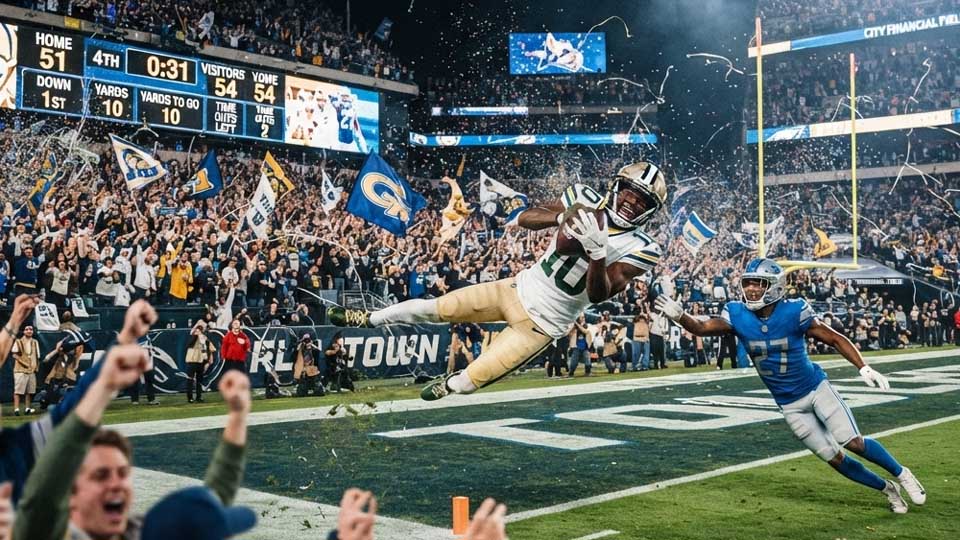
Using TriSync Sports to Find NFL Games That Can Produce Multiple DFS Winners
Sometimes the best DFS play isn't a player.
It's a:
GAME.
Think about what happens when two NFL teams produce a high-scoring, competitive game.
One quarterback throws for 350 yards.
Another throws for 300.
Two receivers go over 100 yards.
A running back scores twice.
A tight end catches another touchdown.
Suddenly, one game has produced:
FIVE OR SIX OF THE BEST DFS SCORES ON THE SLATE.
If we identify that game before it happens?
We don't have to guess which isolated player will score.
We can build around the:
ENTIRE FANTASY ENVIRONMENT.
That's the foundation of the:
TriSync Sports Game Environment Strategy.
What Is a Game Environment?
A game environment describes the conditions that determine how fantasy production may develop within one NFL matchup.
We're interested in questions such as:
Can both teams score?
Can the game stay competitive?
Will both offenses remain aggressive?
Can the quarterbacks generate significant production?
Are there receivers with strong ceiling?
Are the running backs involved in multiple phases?
Does one defense create an especially favorable matchup for the opposing offense?
Most importantly:
CAN THIS GAME CREATE MULTIPLE STRONG DFS SCORES AT THE SAME TIME?
That's what we're searching for.
Why Game Environment Matters
Fantasy production doesn't happen in isolation.
If Team A scores quickly, Team B gets the football back.
If Team B answers, Team A needs to remain aggressive.
More plays.
More passes.
More targets.
More red-zone opportunities.
More touchdowns.
More fantasy points.
That's why competitive high-scoring games can become so valuable.
One team's production can create additional opportunity for:
THE OTHER TEAM.
The Ideal DFS Game Environment
If we could design the perfect GPP game, it might look something like this:
Both offenses are capable of scoring.
Neither defense completely controls the matchup.
Both quarterbacks have upside.
Multiple skill players have strong projections.
The game remains competitive into the fourth quarter.
Neither team can simply run out the clock.
And both sides continue attacking.
That creates:
SUSTAINED FANTASY OPPORTUNITY.
Start With the Team Projections
This strategy begins differently from most of our individual-player strategies.
Instead of starting with:
QB.
RB.
WR.
Or TE.
Start with:
THE TEAMS.
TriSync's Team Projections give us a way to examine the broader matchup.
Look at the:
TEAM OFFENSE PROJECTION.
Remember, TriSync's offensive projection reflects the collective outlook of the offense, with quarterback performance receiving additional weight and offensive linemen receiving less.
Now compare:
TEAM A OFFENSE
against:
TEAM B DEFENSE.
Then reverse it.
TEAM B OFFENSE
against:
TEAM A DEFENSE.
We're looking for games where the relationships create interesting fantasy possibilities.
Strong Offense vs. Weak Defense
This is the easiest environment to identify.
Suppose:
Team A Offense = Strong
and:
Team B Defense = Weak.
Immediately, Team A deserves attention.
Now examine the individual players.
Does the QB carry:
A strong TriSync Projection?
Do the receivers carry:
Large Points Max numbers?
Does the running back have:
Volume?
Does someone carry:
Value+?
Now the team-level matchup and individual projections are beginning to reinforce each other.
That's exactly what we're looking for.
But One Strong Offense Isn't Enough
This is where Game Environment Strategy goes beyond simply finding a good matchup.
Suppose Team A projects extremely well.
But Team B projects poorly.
Maybe Team A jumps ahead:
28-3.
What happens next?
Team A may:
Run more.
Throw less.
Slow the game.
Protect the lead.
Now some of the fantasy opportunity disappears.
Team A may still produce useful DFS scores.
But the game may not develop into the environment we want for a:
FULL GAME STACK.
The Opponent Needs to Participate
For a truly explosive game environment, we often want:
BOTH TEAMS CONTRIBUTING.
Team A scores.
Team B answers.
Team A scores again.
Team B has to throw.
Team A remains aggressive.
That's the cycle.
This is why a competitive:
31-28
type of game can be more attractive for DFS than:
35-7.
The winning team may score a similar number of points.
But the first game can create much more total fantasy production.
Competitive Games Extend Opportunity
Imagine Team A leads:
27-24
with eight minutes remaining.
Can they stop throwing?
Probably not.
They may need another touchdown.
Now Team B gets the ball.
They're still attacking too.
This can continue through the final possession.
That means:
More quarterback attempts.
More receiver targets.
More RB receptions.
More red-zone trips.
More scoring opportunities.
A close game can keep the fantasy faucet running.
Game Environment Isn't the Same as Picking the Winner
This distinction is critical.
We aren't trying to determine:
WHICH TEAM WINS THE FOOTBALL GAME.
We're trying to determine:
WHICH GAME PRODUCES FANTASY POINTS.
A quarterback can have a tremendous DFS performance in a loss.
A receiver can score 30 fantasy points while his team loses.
A running back can catch eight passes because his team trails.
DFS doesn't require us to predict the winner.
It requires us to identify:
PRODUCTION.
Now Move to the Individual DFS Projections
Once a game looks interesting at the team level, move to:
THE PLAYERS.
Now examine the TriSync DFS Projections.
Look at:
Lineup Signal
Output Level
Points Min
Points Max
and
Salary.
We're asking:
Does the individual player data confirm the game-level opportunity?
We Want Multiple Strong Players
This is one of the most important concepts in the strategy.
Suppose Team A has a strong offensive projection.
But only one individual player has an attractive DFS profile.
That may simply be:
ONE GOOD PLAY.
Now imagine another game where:
QB A rates strongly.
WR A1 has a large Points Max.
WR A2 carries Value+.
RB A has a strong Value Projection.
QB B also rates strongly.
WR B1 has a large Points Max.
That's different.
Now we may have:
A GAME ENVIRONMENT.
Look for Clusters
This is a useful way to think about it.
We're looking for:
CLUSTERS OF TRISYNC OPPORTUNITY.
Not simply one player.
Maybe one game contains:
Two strong QB projections
Three Value+ receivers
Two large Points Max numbers
and
a high-value running back.
That deserves attention.
When multiple players from the same game rise toward the top of the TriSync DFS board?
The game itself may be telling us something.
Quarterback Is the Engine
For passing-oriented game environments, start with the quarterbacks.
Does QB A have:
Strong TriSync Projection?
Strong Value Projection?
Premium or Core signal?
Large Points Max?
Now check QB B.
If both quarterbacks rate well?
That's particularly interesting.
Why?
Because quarterback production often creates:
RECEIVER PRODUCTION.
A 350-yard, three-touchdown QB performance means someone is catching those passes.
Find Where the Quarterback Production Goes
This is the next question.
If QB A reaches his ceiling:
WHO BENEFITS?
WR1?
WR2?
TE?
Receiving RB?
Now examine those players through TriSync.
Maybe WR1 has:
Premium.
WR2 has:
Value+.
TE has:
Value.
Now we can begin building a picture of how the offense may produce.
Points Max Is Critical
Game Environment Strategy is especially useful for:
GPPs.
That means we care about:
POINTS MAX.
We're searching for games containing multiple players with meaningful upper-end scoring potential.
Imagine Game A has:
QB: Points Max 38
WR1: 35
WR2: 29
Opposing WR1: 36
Opposing QB: 34
That's interesting.
Multiple players have legitimate paths toward tournament-level scores.
Now compare that with a game where every player's Points Max sits around:
18-22.
The first environment provides much more upside.
TriSync Value Projection Keeps the Stack Affordable
Here's the challenge.
We may love:
QB.
WR1.
WR2.
And the opposing WR1.
But can we afford them?
That's where:
TRISYNC VALUE PROJECTION
becomes extremely important.
Maybe WR2 carries:
VALUE+
at a moderate salary.
Maybe the opposing TE has:
Strong Value Projection.
Maybe the quarterback himself is inexpensive.
Now the game environment isn't simply attractive.
It's:
BUILDABLE.
That's important.
The Best Game Isn't Always the Best DFS Game
Suppose everyone is excited about:
Chiefs vs. Bills.
Or another marquee matchup.
Great football game.
But that doesn't automatically make it:
THE BEST DFS ENVIRONMENT.
Maybe salaries are extremely high.
Maybe TriSync Value Projections aren't particularly attractive.
Maybe several players have limited Points Max relative to cost.
Meanwhile, a less glamorous matchup contains:
Multiple Value+ players.
Strong QB projections.
Large WR Points Max.
And affordable salaries.
That's the game we want to investigate.
Don't Draft the Logo
This is an important rule.
Don't build around a game simply because the teams are famous.
Don't build around:
Reputation.
Television coverage.
Narrative.
Or last week's score.
Build around:
TODAY'S OPPORTUNITY.
TriSync helps us evaluate the current game rather than the brand names playing in it.
High-Scoring Doesn't Automatically Mean Good DFS
This may sound strange.
Imagine a game finishes:
34-31.
Great DFS environment, right?
Maybe.
But what if the touchdowns are spread among:
Eight different players?
One defensive touchdown.
One kickoff return.
A backup tight end touchdown.
A rushing QB touchdown.
A fullback touchdown.
Lots of points.
But not necessarily concentrated fantasy production.
For DFS, we prefer environments where production has a reasonable chance to flow through:
THE PLAYERS WE CAN IDENTIFY.
Concentrated Opportunity Matters
Suppose Team A's offense revolves around:
QB.
WR1.
RB1.
TE.
That's fairly concentrated.
Now suppose Team B uses:
Three RBs.
Four WRs.
Two TEs.
And multiple gadget players.
Fantasy production may be much harder to predict.
This doesn't make Team B unusable.
But concentrated roles can make a game easier to attack.
Game Environment + QB Stack
This is the natural starting point.
Find an attractive game.
Identify the strongest quarterback.
Pair him with:
AN ELIGIBLE PASS CATCHER.
WR.
TE.
Or an RB averaging at least five passing targets per game.
Now we have:
QB STACK.
If the game environment hits, the correlated pair can score together.
Game Environment + Double Stack
If multiple pass catchers rate strongly?
Consider:
QB + TWO TEAMMATES.
Maybe:
QB + WR + WR.
QB + WR + TE.
QB + WR + receiving RB.
Now we're capturing a larger percentage of the offense.
This becomes especially attractive when TriSync supports:
BOTH PASS CATCHERS.
Game Environment + Bring-Back
Now connect the other side.
Suppose QB A and WR A rate strongly.
Team B has a WR with:
Large Points Max.
Strong Value Projection.
And Premium signal.
Now we have:
QB A + WR A + WR B.
That's the classic:
GAME STACK / BRING-BACK.
What's the story?
WR B scores.
Team A has to keep attacking.
QB A throws.
WR A catches.
The players help create opportunities for each other.
The Bring-Back Doesn't Have to Be a Receiver
This is important.
The opposing Bring-Back can be:
WR.
TE.
RB.
Or another appropriate offensive player.
And remember:
An opposing RB does:
NOT
need five targets per game to qualify as a Bring-Back.
Why?
We're not directly correlating him with our quarterback.
We're using him to help create the:
GAME ENVIRONMENT.
If the opposing RB scores twice, our quarterback's offense may need to remain aggressive.
That's enough.
Receiving Backs Are Especially Interesting
A running back with strong receiving involvement can fit almost any game script.
If his team leads?
Carries.
If the game stays close?
Carries and receptions.
If his team trails?
Targets.
That's why versatile running backs can be excellent Game Environment pieces.
They don't require one exact script to succeed.
Game Environment + WR Ceiling
This combination is extremely powerful.
Our previous strategy asked:
WHICH RECEIVERS CAN BREAK THE SLATE?
Now we're asking:
WHICH GAME GIVES THEM THE BEST CHANCE TO DO IT?
A high-ceiling WR becomes even more attractive when:
His QB rates strongly.
The opposing offense can answer.
The game may stay competitive.
And the defense isn't expected to shut everything down.
That's how individual ceiling and game environment work together.
Game Environment + RB Volume
Running backs can benefit too.
Suppose a high-volume RB plays in a strong offensive environment.
Now he may receive:
Carries.
Targets.
Red-zone work.
Goal-line opportunities.
And more total scoring chances.
If his team is expected to move the football consistently, his volume becomes more valuable.
That's especially true for:
THREE-DOWN BACKS.
Game Environment + TriSync Value Projection
A game can be attractive but too expensive.
This is where our Value Strategy becomes important.
Search the environment for:
VALUE+ AND VALUE.
Maybe we can't afford:
QB + WR1 + WR2 + opponent WR1.
But perhaps:
QB + WR2 + TE + opponent WR1
provides comparable game exposure at a much lower salary.
We're still betting on the environment.
We're simply accessing it differently.
Game Environment + Marquee & Marginal
This is another natural combination.
Maybe the game contains one:
MARQUEE RECEIVER.
We want him.
Fine.
Now use a:
MARGINAL-SALARY
WR2 or TE from the same environment with strong TriSync support.
Maybe the opposing Bring-Back is also inexpensive.
Now we've captured the game without consuming the entire salary cap.
Game Environment + Contrarian Leverage
This can become one of the strongest GPP combinations.
Suppose everyone wants Game A.
TriSync shows strong conditions in:
GAME B.
Game B contains:
Strong QB Value Projection.
Two large WR Points Max numbers.
A Value+ opposing receiver.
And favorable team-level projections.
But it isn't attracting the same attention.
Now we have:
GAME LEVERAGE.
If Game B becomes the slate's shootout?
We've gained against a large portion of the field.
Don't Force the Popular Shootout
This is a major tournament mistake.
Everyone identifies one game as:
THE SHOOTOUT.
Then everyone stacks it.
There's nothing wrong with using that game if TriSync supports it.
But don't assume:
POPULAR = BEST.
Compare the environment with other games.
Maybe another matchup offers:
Similar Points Max.
Better Value Projections.
Lower salaries.
And less obvious players.
That's where tournament leverage can appear.
One-Sided Environments Can Still Work
Not every useful environment needs both teams.
Suppose:
Team A offense rates extremely well.
Team B defense rates poorly.
But Team B offense also looks weak.
Maybe the game isn't ideal for a Bring-Back.
Fine.
We might still build:
QB A + WR A + WR A2
without forcing an opponent.
Or:
RB A + D/ST A
if we expect Team A to control the game.
The environment tells us:
HOW TO BUILD.
It doesn't force one construction.
Strong Offense + Strong D/ST
This can create a completely different game story.
Suppose Team A has:
Strong offensive projection.
Strong D/ST projection.
Team B offense projects poorly.
Now perhaps the story is:
Team A gets ahead.
Team B struggles.
Team A's RB receives heavy second-half volume.
Team A's D/ST creates sacks and turnovers.
That suggests:
RB + D/ST CORRELATION.
Game Environment Strategy isn't only about shootouts.
It's about understanding:
HOW THE GAME MAY CREATE FANTASY PRODUCTION.
Low-Scoring Environments Can Be Useful Too
Suppose both offenses project poorly.
Both defenses rate strongly.
That's information.
Maybe we don't want offensive stacks from this game.
But one of the D/ST units may offer:
Strong Value Projection.
Large Points Max.
And a favorable opposing offense matchup.
Now the game environment has identified:
A DEFENSIVE DFS OPPORTUNITY.
That's still valuable.
There Are Different Types of DFS Environments
Think of NFL games as falling into several broad fantasy stories.
1. SHOOTOUT
Both offenses produce.
Best for:
QB stacks.
Double stacks.
Bring-Backs.
WR Ceiling.
2. ONE-SIDED OFFENSIVE GAME
One offense dominates.
Best for:
QB stacks.
Team stacks.
RB volume.
Possibly no Bring-Back.
3. POSITIVE RB SCRIPT
One team gets ahead and controls the game.
Best for:
High-volume RB.
D/ST correlation.
4. TRAILING PASSING SCRIPT
One team falls behind and throws heavily.
Best for:
QB.
WR.
TE.
Receiving RB.
5. DEFENSIVE GAME
Both offenses struggle.
Best for:
D/ST.
Possibly limited offensive exposure.
The goal is to determine:
WHICH STORY TRISYNC SUPPORTS.
Don't Assume the Game Script Is Guaranteed
This is important.
We're building around:
PROBABILITIES.
Not certainties.
A game expected to shoot out can finish:
17-13.
A heavy favorite can fall behind.
A defensive matchup can suddenly produce 60 points.
That's football.
Game Environment Strategy doesn't eliminate uncertainty.
It helps us build lineups where:
MULTIPLE SELECTIONS CAN BENEFIT IF OUR GAME READ IS CORRECT.
That's the advantage.
Use Multiple Paths in GPPs
If you're entering multiple tournament lineups, Game Environment Strategy becomes especially useful.
Suppose you love one game.
You don't necessarily need the same stack every time.
You could build:
Lineup A
QB + WR1 + Opposing WR1
Lineup B
QB + WR2 + Opposing WR1
Lineup C
QB + WR1 + TE + Opposing RB
Lineup D
QB + WR2 + TE + Opposing WR2
Same game.
Different paths.
Now you're betting on:
THE ENVIRONMENT
without requiring one exact distribution of fantasy production.
Use TriSync to Choose the Paths
Don't randomly rotate players.
Let:
TriSync Projection
Value Projection
Lineup Signal
Output Level
and
Points Max
determine which combinations deserve exposure.
We're not trying to cover every possible outcome.
We're trying to cover:
THE STRONGEST TRISYNC-SUPPORTED OUTCOMES.
A Hypothetical Game Environment
Imagine:
Team A vs. Team B
Team A QB
TriSync Value Projection: 3.30
Points Max: 40
Lineup Signal: Core
Team A WR1
Value Projection: 2.90
Points Max: 37
Signal: Premium
Team A WR2
Value Projection: 3.25
Points Max: 31
Signal: Value+
Team A RB
Value Projection: 2.70
Points Max: 32
Signal: Premium
Team B QB
Value Projection: 3.05
Points Max: 36
Signal: Premium
Team B WR1
Value Projection: 3.15
Points Max: 35
Signal: Value+
Now we have:
Two quarterbacks with strong upside.
Three receivers with significant Points Max.
Multiple strong Value Projections.
And several attractive Lineup Signals.
That's not simply:
A GOOD PLAYER.
That's:
A GAME WORTH INVESTIGATING.
Now Build the Story
Maybe our construction becomes:
QB A + WR A1 + WR B1.
Simple Game Stack.
Or:
QB A + WR A1 + WR A2 + WR B1.
Double Stack with Bring-Back.
Or maybe WR A2 provides enough Value that we can use:
QB A + WR A2 + WR B1
and spend Marquee salary elsewhere.
The environment identifies the game.
TriSync helps determine:
HOW WE ACCESS IT.
The Best Game Environment Doesn't Need Every Player
This is another common mistake.
We identify a great game and suddenly want:
EVERYONE.
That's not necessary.
Maybe six players from the game look interesting.
We still need to identify:
THE BEST COMBINATION.
Use:
Projection.
Value.
Ceiling.
Salary.
Correlation.
Lineup Signal.
And role.
The environment narrows the search.
It doesn't eliminate player selection.
Don't Overstack Without a Reason
If you roster:
Five players from one game,
you're making a very strong statement.
That game needs to produce enormous fantasy scoring.
Sometimes that's a perfectly reasonable GPP strategy.
But understand what you're doing.
The more players you add from one environment, the more dependent your lineup becomes on:
THAT ONE GAME.
Make sure the ceiling justifies the concentration.
Four Players Can Be a Sweet Spot
A construction such as:
QB + WR + WR + Bring-Back
can provide significant exposure without consuming the entire lineup.
Or:
QB + WR + Bring-Back
may be enough.
There's no magic number.
The correct amount depends on:
The game.
The salaries.
The TriSync projections.
And the rest of the slate.
Salary Still Controls Everything
A beautiful game environment can still create a bad lineup if the salaries don't work.
Always ask:
WHAT AM I SACRIFICING TO BUILD THIS STACK?
If stacking four expensive players forces us into:
Two Filler plays.
A desperate Punt.
And a weak D/ST.
Maybe we've gone too far.
TriSync Value Projection can help us find less expensive access to the same environment.
The TriSync Game Environment Checklist
Before building around a game, ask:
1. How does Team A's offense project?
Start at the team level.
2. How does Team B's defense project?
Look at the matchup.
3. How does Team B's offense project?
Can the opponent participate?
4. How does Team A's defense project?
Evaluate both sides.
5. Can the game stay competitive?
Competitive games can extend fantasy opportunity.
6. Do both quarterbacks have useful TriSync outlooks?
QB performance often drives the environment.
7. Which receivers have the largest Points Max?
Find the ceiling.
8. Which players carry strong TriSync Value Projections?
The stack must fit the salary cap.
9. What are the Lineup Signals?
Look for Core, Premium, Value+ and Value.
10. What are the Output Levels?
Use them as additional performance context.
11. Is offensive production concentrated?
Can we identify where the fantasy points are likely to go?
12. Is there a logical QB Stack?
Start building correlation.
13. Is there a second stacking partner?
Consider Double Stack.
14. Is there a strong Bring-Back?
Connect both sides of the game.
15. Could a receiving RB fit?
Versatility can survive multiple scripts.
16. Does an RB + D/ST construction make more sense?
Not every environment is a shootout.
17. Am I forcing a Bring-Back?
Don't use one simply because the strategy has a name.
18. Is the game popular?
Consider Contrarian Game Leverage.
19. Can I access the environment more cheaply?
Use TriSync Value Projection.
20. Does every player fit the same game story?
That's the final test.
Think Game First, Players Second
That's the biggest change with this strategy.
Most DFS decisions begin with:
PLAYER A vs. PLAYER B.
Game Environment Strategy begins with:
GAME A vs. GAME B.
Which matchup creates the strongest opportunity for concentrated fantasy production?
Then:
Which quarterback benefits?
Which receiver?
Which second receiver?
Which RB?
Which opposing player?
Which Value+ selection makes the stack affordable?
Now we're building players around:
AN EXPECTED FOOTBALL STORY.
Conclusion: Find Where the Fantasy Points Can Gather
The best DFS scores aren't always evenly distributed across the slate.
Sometimes they gather in:
ONE GAME.
That's what we're trying to find.
Start with the:
TEAM PROJECTIONS.
Compare:
Offense vs. Defense
on both sides.
Then move to the individual DFS projections.
Look for:
Strong TriSync Projections
High TriSync Value Projections
Large Points Max
Core, Premium, Value+ and Value Lineup Signals
and
favorable Output Levels.
Most importantly:
Look for:
CLUSTERS.
Multiple players.
Same game.
Strong TriSync support.
Then determine the story.
Shootout?
One-sided offense?
Positive RB script?
Trailing passing script?
Defensive battle?
Build accordingly.
Don't stack a game because everyone says it will shoot out.
Don't force an opponent into the lineup simply because you want a Bring-Back.
Don't assume the highest-scoring real football game automatically produces the best DFS environment.
Find the game where:
THE FANTASY OPPORTUNITY IS CONCENTRATED.
Then use:
QB Stack.
Double Stack.
Bring-Back.
WR Ceiling.
RB Volume.
TriSync Value.
Marquee & Marginal.
And Contrarian Leverage
to decide how you want to attack it.
Read the teams.
Find the game.
Find the Value.
Find the ceiling.
Build the correlation.
Capture the environment.
That's the TriSync Sports Game Environment Strategy.
Bet responsibly. Past performance of any analytical system does not guarantee future results. TriSync Sports is intended as an informational and entertainment tool.