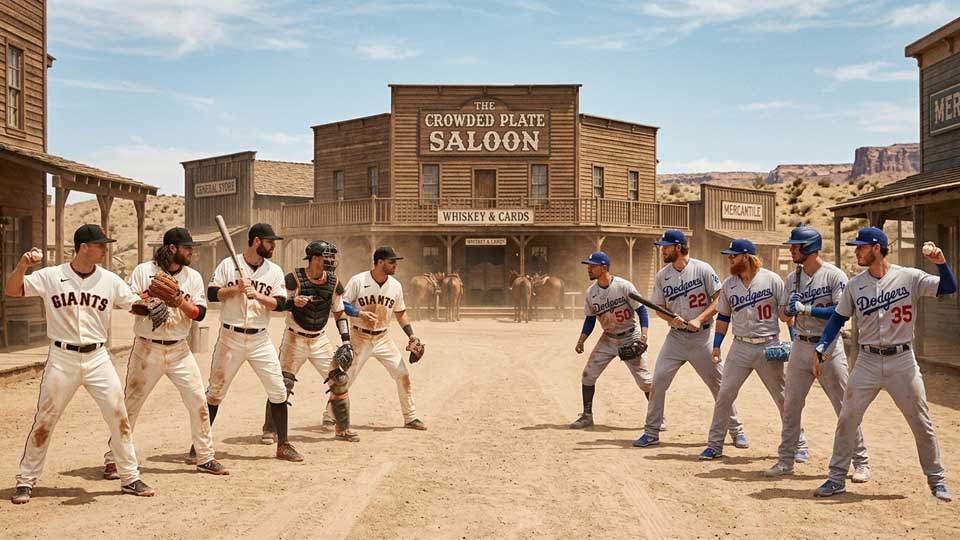
Using TriSync Sports to Build a Six-Player DFS Lineup Around One MLB Game
As the MLB season reaches October, something changes for DFS players.
The schedule gets smaller.
The choices get fewer.
And eventually, the most interesting DFS contests revolve around:
ONE GAME.
That's where the:
MLB SHOWDOWN
becomes important.
Instead of choosing players from games across the league, we're building an entire DFS lineup from one matchup.
Six selections.
One game.
One $50,000 salary cap.
And in Captain Mode:
One Captain who scores 1.5× fantasy points while also costing 1.5× his normal salary.
Position requirements disappear.
Pitchers and hitters compete for the same six roster positions.
And because every selection comes from the same game, correlation becomes enormously important.
Welcome to the:
TriSync Sports MLB Showdown Strategy.
Showdown Changes Everything
Traditional MLB DFS gives us a large player pool.
Multiple starting pitchers.
Dozens of teams.
Hundreds of hitters.
Showdown strips that away.
Now we may have only:
Two starting pitchers.
Eighteen starting hitters.
Bullpen options when available.
And a handful of bench players who might eventually enter the game.
We're choosing six.
That means we need to think differently.
The question isn't:
Who are the best players tonight?
It's:
Which six players create the best lineup for THIS game?
Start With the Game
Before selecting anyone, understand the matchup.
Ask:
Who are the starting pitchers?
Which offense has the stronger matchup?
Which hitters are at the top of the batting order?
Where are the platoon advantages?
Which pitcher has the greater strikeout potential?
Which hitters have the greatest power and speed upside?
What are the TriSync Performance Windows?
What are the TriSync Projections?
And perhaps most importantly:
What type of game are we expecting?
A pitcher's duel?
A high-scoring game?
One dominant pitcher?
One offense controlling the game?
A close game where both sides produce?
Your six-player lineup should reflect the answer.
Build a Baseball Story
The same principle we use for NFL Showdown becomes even more interesting in baseball.
Your lineup should tell a:
GAME STORY.
Suppose you believe Pitcher A dominates.
What follows?
Maybe you Captain Pitcher A.
You probably don't want to load the rest of the lineup with hitters facing him.
Instead, you may combine Pitcher A with several hitters from his own offense.
Now suppose you believe both starting pitchers will struggle.
That's a completely different story.
Maybe you fade both pitchers.
Captain a hitter.
Stack several hitters from one offense.
Then bring back one or two bats from the other side.
The lineup reflects what you expect to happen.
The Captain Decision Comes First
The Captain receives:
1.5× fantasy points.
But also costs:
1.5× salary.
That makes Captain the most important salary decision in the lineup.
And MLB gives us a fascinating choice:
PITCHER OR HITTER?
The answer can completely change the construction.
Starting Pitcher at Captain
A dominant starting pitcher may be one of the strongest Captain options available.
Why?
Because pitchers can accumulate fantasy points through repeated events.
Strikeout after strikeout.
Inning after inning.
Out after out.
A hitter might receive:
4-5 plate appearances.
A starting pitcher could face:
20-30 batters.
That creates a very different fantasy opportunity.
If a pitcher carries:
A strong TriSync Projection
An Excellent or Good Performance Window
An Aligned Profile
Strong strikeout potential
A favorable matchup
and
a reasonable path toward pitching deep into the game,
he deserves serious Captain consideration.
But Pitcher Captain Is Expensive
Elite starting pitchers are frequently among the most expensive selections.
And Captain salary multiplies that cost by:
1.5.
Suppose the starting pitcher costs:
$11,800 at UTIL.
At Captain, he costs:
$17,700.
That leaves:
$32,300
for five additional selections.
Average remaining salary:
$6,460.
That's tight.
So the question isn't simply:
“Is this the best pitcher?”
It's:
“Does using this pitcher at Captain create the strongest six-player lineup?”
That's a much better question.
Hitter at Captain
Hitters provide a completely different path.
A batter can generate fantasy points through:
Singles
Doubles
Triples
Home runs
Runs
RBI
Walks
and
Stolen bases.
A multi-hit game with a home run can quickly become Captain-worthy.
A hitter with both:
POWER + SPEED
can become particularly interesting because he has multiple paths toward an explosive score.
If TriSync identifies a hitter with:
A strong Projection.
A favorable Performance Window.
And a desirable position in the batting order.
He deserves Captain consideration.
Top-of-Order Hitters Have an Advantage
This is especially important in Showdown.
We already emphasize batting order in the Top-of-Order strategy.
Here it becomes even more valuable.
A hitter batting:
1st
is more likely to receive an additional plate appearance than someone batting:
8th or 9th.
In a one-game contest, one extra plate appearance can be enormous.
One additional opportunity can become:
A hit.
A walk.
A stolen base.
A run.
An RBI.
Or a home run.
When two hitters have similar TriSync outlooks, batting-order position can become an important tiebreaker.
Don't Select the Captain Before Seeing the Lineup
This is particularly important in baseball.
Wait for confirmed batting orders whenever possible.
A hitter you expected to bat:
2nd
may be hitting:
7th.
Another hitter may unexpectedly move into:
Leadoff.
That changes opportunity.
And opportunity matters enormously when every plate appearance counts.
Your final Captain decision should account for:
Confirmed batting position
Starting pitcher matchup
TriSync Projection
Performance Window
Value
and
Salary.
The Value Captain
This is one of the most interesting Showdown concepts.
Suppose an elite hitter costs:
$10,400 UTIL
and:
$15,600 Captain.
Now suppose another hitter costs:
$6,400 UTIL
and:
$9,600 Captain.
That's:
$6,000 in savings.
Maybe the cheaper hitter is:
Batting second.
In an Excellent Performance Window.
Carrying a strong TriSync Projection.
And facing a favorable pitcher matchup.
He doesn't necessarily project better than the superstar.
But what does the:
$6,000 SAVINGS
allow us to do?
Maybe now we can roster:
Both starting pitchers.
Two premium hitters.
And another strong bat.
That's why Captain should always be evaluated as part of the:
COMPLETE SIX-PLAYER LINEUP.
Starting Pitchers Create Negative Correlation
This is one of the biggest differences between NFL and MLB Showdown.
If Pitcher A dominates:
Hitters from Team B probably aren't dominating.
That's negative correlation.
Suppose Pitcher A throws:
7 innings
10 strikeouts
1 run allowed.
That's excellent for the pitcher.
But it probably means most opposing hitters produced poor fantasy totals.
That's important when constructing the lineup.
Don't Stack Hitters Against Your Captain Pitcher Without a Reason
Suppose your Captain is:
Pitcher A.
Then you roster:
Three hitters from Team B.
Ask yourself:
What game story am I telling?
Can the pitcher have a Captain-worthy performance while three opposing hitters also produce tournament-winning scores?
It's possible, but very unlikely.
The paths begin fighting each other.
That's a warning.
Correlation matters.
One Opposing Hitter Can Still Make Sense
Don't take negative correlation too far.
Baseball isn't all or nothing.
A pitcher can have a strong game while one opposing hitter produces.
Maybe the pitcher throws seven excellent innings but allows:
One solo home run.
That hitter can still deliver a useful DFS performance.
So:
Captain Pitcher + one opposing power hitter
can make sense.
But:
Captain Pitcher + three opposing hitters
usually tells a much more confusing story.
Can You Use Both Starting Pitchers?
Absolutely.
And in the right game, it can be very attractive.
Suppose both starters have:
Strong TriSync Projections.
Good or Excellent Performance Windows.
Strikeout upside.
And favorable overall conditions.
If we're expecting:
A LOW-SCORING PITCHER'S DUEL,
using both starters can make sense.
Maybe one is Captain.
The other is UTIL.
Then fill the remaining positions with the hitters most likely to generate whatever offense does occur.
That's a coherent lineup.
Both Pitchers Aren't Mandatory
Don't automatically select both simply because they're starting pitchers.
Suppose Pitcher A has:
A strong TriSync Projection.
An Excellent window.
And significant strikeout upside.
Pitcher B has:
A weak Projection.
A Suboptimal window.
Poor recent command.
And a difficult opposing lineup.
Why use Pitcher B simply because he's starting?
There are no positional requirements forcing us to.
That's one of the great advantages of Showdown.
Use the flexibility.
A Weak Pitcher Can Create the Stack
This is where TriSync can become extremely powerful.
Suppose Pitcher B is projected poorly.
Maybe he's:
Suboptimal.
Meanwhile, several hitters from Team A carry:
Excellent
or
Good
Performance Windows.
Now we have the beginnings of a Showdown strategy.
Instead of using Pitcher B:
ATTACK HIM.
Build a group of Team A hitters.
That's a natural extension of the TriSync:
Performance Window Stack Strategy.
Hitter Stacking Still Matters
Even though we're only choosing six players, baseball correlation remains important.
Suppose:
Batter 1 gets on base.
Batter 2 doubles him home.
What happens?
Batter 1 scores fantasy points for:
Getting on base
and
Scoring a run.
Batter 2 scores for:
The double
and
RBI.
Two players benefit from the same offensive sequence.
That's why adjacent hitters can be so valuable.
Top-of-Order Mini Stacks
One of the easiest Showdown constructions is:
1-2-3
from the same lineup.
Or:
1-2
with another hitter later in the order.
Why?
Plate appearances.
Correlation.
Runs.
RBI.
If the top of the order repeatedly gets on base, those players can produce fantasy points together.
And because Showdown removes positional requirements, we don't care whether they're:
Two outfielders.
Two infielders.
A catcher and an outfielder.
Position doesn't matter.
Production does.
Look for RBI Connections
TriSync's RBI concepts become particularly useful here.
Suppose the leadoff hitter carries:
A strong on-base opportunity.
The No. 2 hitter also rates strongly.
And the No. 3 hitter has:
Premium RBI potential.
Now:
1 + 2 + 3
creates a logical mini-stack.
If the first two reach base and No. 3 drives them home, all three selections benefit.
That's exactly the kind of correlation we want.
Power Can Change the Entire Contest
Home runs are always important in MLB DFS.
In Showdown, their impact becomes even larger.
Why?
The player pool is smaller.
Everyone is drawing from the same game.
One hitter producing:
TWO HOME RUNS
can become extremely difficult to overcome if you don't have him.
That's why power hitters with strong TriSync support deserve serious Captain consideration in GPPs.
Especially when facing:
A vulnerable pitcher.
A favorable handedness matchup.
Or a bullpen likely to present additional opportunities.
Don't Forget Stolen Bases
Speed provides another path toward ceiling.
A hitter doesn't necessarily need a home run to deliver a big Showdown score.
A player can:
Single.
Steal second.
Score.
Then later:
Walk.
Steal again.
Now he's accumulating fantasy points without leaving the ballpark.
If TriSync identifies a strong Performance Window for a hitter who also carries meaningful stolen-base upside, don't overlook him.
Batting Order Matters More Than Position
In Classic DFS, we have to think about:
Catcher.
First base.
Second base.
Third base.
Shortstop.
Outfield.
Not here.
Showdown doesn't care.
That means batting-order position becomes much more useful than defensive position.
I'd rather know:
Is he batting 1st or 8th?
than:
Does he play second base or left field?
The first question affects fantasy opportunity.
The second doesn't matter for Showdown lineup construction.
Salary Is a Major Part of the Strategy
Showdown creates a small player pool.
The premium players are obvious.
The challenge is fitting them together.
Suppose we want:
Pitcher A.
Pitcher B.
Star Hitter A.
Star Hitter B.
Suddenly we've consumed most of the salary cap.
Now we need two more selections.
This is where:
TriSync Projection
becomes critical.
We need to identify the lower cost hitters at a favorable performance level for them.
Finding Value Can Unlock the Entire Lineup
Imagine a hitter costs:
$4,800.
He's batting:
2nd.
He carries:
A strong TriSync Projection.
And an Excellent Performance Window.
That player can become enormously important.
He's not simply a cheap hitter.
He's a player with legitimate opportunity at a salary that allows us to roster expensive pitchers and premium bats elsewhere.
That's exactly what we want.
Cheap Doesn't Mean Value
Suppose another hitter costs:
$3,000.
Sounds great.
But he's:
Batting ninth.
In a Suboptimal performance window.
Facing an elite pitcher.
And carrying a poor TriSync Projection.
That's not necessarily value.
He's simply:
CHEAP.
Never confuse the two.
The best Showdown salary savers have:
Low salary + legitimate opportunity.
The Bottom of the Order Isn't Automatically Off Limits
There are exceptions.
Suppose a hitter batting eighth costs very little.
But TriSync shows:
An Excellent Performance Window.
A strong Projection, especially at his salary.
And meaningful power.
Now he may be worth consideration.
Especially in GPPs.
Why?
Because the public naturally gravitates toward the top of the lineup.
A lower-order hitter with legitimate power and strong TriSync conditions can create differentiation.
Again:
Don't be different randomly.
Have a reason.
Bullpen Matters
Showdown doesn't end when the starting pitcher leaves.
That's especially important during the playoffs.
Managers can become much more aggressive with:
Bullpen usage.
A hitter may face the starting pitcher twice.
Then face:
Two or three different relievers.
That changes the matchup throughout the game.
When evaluating hitters, don't think exclusively about:
Starter vs. Batter.
Think about:
Batter vs. the entire pitching path.
Relief Pitchers Can Enter the Conversation
One unique element of MLB Showdown is that the available player pool can sometimes make relief pitchers usable.
But this is generally a high-risk strategy.
Why?
Their innings are limited.
Usage may be uncertain.
And predicting exactly which reliever appears can be difficult.
Still, in unusual circumstances, a dominant reliever with strikeout ability can provide inexpensive fantasy production.
This is much more of a:
GPP consideration
than a cash strategy.
Don't use a reliever simply because he's cheap.
You need a legitimate reason to expect:
Usage + strikeouts + opportunity.
Playoff Baseball Changes Pitcher Expectations
This deserves special attention.
October baseball is different.
Managers don't always allow a struggling starter to work through trouble.
A pitcher who might receive:
100 pitches
during the regular season could be removed much earlier if the game begins slipping away.
That matters for DFS.
Before paying a premium salary for a postseason pitcher, consider:
How deep is he likely to pitch?
How strong is the bullpen?
How quickly might the manager make a change?
Is the starter on normal rest?
Has he recently pitched?
TriSync provides the performance outlook.
But postseason managerial context still matters.
Game 1 Is Different From Game 5
Postseason context can also change bullpen availability.
Suppose a team's elite relievers were heavily used the night before.
That could affect:
Today's hitter outlook.
Or perhaps it's an elimination game.
Now the manager may be willing to use every elite bullpen arm available.
The Showdown strategy should incorporate:
Current series context.
We're analyzing one game.
But that game exists inside a postseason series.
Pitcher Captain + Own-Team Hitters
This is one of the cleanest constructions.
Suppose Pitcher A has a tremendous TriSync outlook.
Captain him.
Then use:
3-4 hitters from Team A
depending upon salary and construction.
What's the story?
Pitcher A dominates.
Team A scores enough runs to win.
The opposing offense struggles.
Simple.
Logical.
Correlated.
Hitter Captain + Own-Team Stack
Now suppose Pitcher B looks vulnerable.
Captain:
Hitter A.
Then add:
Hitter B
and
Hitter C
from the same offense.
Now we're betting on:
TEAM A'S OFFENSE.
Maybe we also use Team A's starting pitcher.
Then bring back one or two Team B hitters.
Again:
The lineup tells a story.
Hitter Captain + Opposing Pitcher?
Be careful.
Suppose you Captain a hitter facing Pitcher B.
Then you also roster Pitcher B.
Can both succeed?
Yes.
The hitter could homer while the pitcher dominates everyone else.
But you're creating some negative correlation.
That doesn't automatically make the lineup wrong.
It simply means:
Understand what you're asking to happen.
If the hitter needs three hits and two home runs to reach Captain ceiling, that's probably bad news for the opposing pitcher.
Make sure the two selections aren't fighting each other too much.
Pitcher vs. Hitter Captain Decision
Here's a simple way to think about it.
Consider a pitcher Captain when:
Strikeout ceiling is high.
TriSync Projection is strong.
Performance Window is favorable.
Opponent appears vulnerable.
Pitch count/workload looks secure.
Consider a hitter Captain when:
Power ceiling is strong.
Batting-order position is favorable.
TriSync Projection is strong.
Performance Window is favorable.
Pitching matchup is attackable.
Salary savings improve the remaining lineup.
There's no automatic answer.
Let the game determine it.
Cash Showdown Strategy
For cash contests, prioritize:
FLOOR.
That generally means greater interest in:
Starting pitchers with strong outlooks
Top-of-order hitters
High-contact hitters
Players with multiple paths toward points
Strong TriSync Projections
and
Aligned profiles.
Avoid loading the lineup with:
Low-order power-only hitters.
Speculative pinch hitters.
Uncertain relievers.
Or players who need a home run to become useful.
Cash is about:
Reaching the cash line.
GPP Showdown Strategy
Tournaments are different.
Now we're chasing:
CEILING.
That can mean:
Power hitters.
Stolen-base threats.
Contrarian Captains.
Lower-order home-run hitters.
Aggressive team stacks.
Pitcher fades.
And occasionally unusual constructions.
But the rule remains:
Have a reason.
TriSync should support the possibility.
We're not trying to create a weird lineup.
We're trying to create a:
DIFFERENT PLAUSIBLE OUTCOME.
Don't Automatically Use All $50,000
Showdown has a small player pool.
That creates duplication.
Many contestants will naturally land on similar combinations.
Especially if everyone tries to use:
Exactly $50,000.
Leaving:
$200
$500
$800
or sometimes more
unused can create a different lineup.
But don't sacrifice significant expected production merely to be unique.
Salary left over should be:
A strategic consequence.
Not the objective.
A Hypothetical TriSync MLB Showdown
Imagine:
Pitcher A
UTIL Salary: $11,600
TriSync Projection: 6.30
Performance Window: Excellent
Profile: Aligned
Pitcher B
UTIL Salary: $10,400
TriSync Projection: 4.65
Performance Window: Fair
Profile: Variable
Hitter A1
UTIL Salary: $9,800
TriSync Projection: 6.00
Window: Excellent
Batting: 1st
Hitter A2
UTIL Salary: $7,200
TriSync Projection: 5.70
Window: Excellent
Batting: 2nd
Hitter A3
UTIL Salary: $6,200
TriSync Projection: 5.45
Window: Good
Batting: 4th
Hitter B1
UTIL Salary: $8,600
TriSync Projection: 5.55
Window: Good
Batting: 1st
Immediately, a story begins forming.
Pitcher A looks strong.
Pitcher B looks vulnerable.
Team A's top hitters look strong.
Now we might build around:
Pitcher A + Team A hitters.
That's TriSync helping identify the game script.
Now Test the Captain
If Pitcher A costs:
$11,600 UTIL
he becomes:
$17,400 at Captain.
That's expensive.
What happens if Hitter A2 costs:
$7,200 UTIL
and:
$10,800 at Captain?
We save:
$6,600.
Hitter A2 doesn't project as highly.
But the savings may allow us to roster:
Pitcher A.
Hitter A1.
Hitter A3.
And two additional quality selections.
Again:
Don't compare Captains alone.
Compare the six-player lineups they create.
The MLB Showdown Checklist
Before submitting the lineup, ask:
1. What type of game am I expecting?
Pitcher's duel? Offensive game? One-sided matchup?
2. Which starting pitcher has the strongest TriSync outlook?
Projection, Window and Profile matter.
3. Who are my Captain candidates?
Consider both pitchers and hitters.
4. What does each Captain cost?
The 1.5× salary matters enormously.
5. What lineup does each Captain allow me to build?
Always compare all six selections.
6. Have the batting orders been confirmed?
Don't underestimate this.
7. Where are my hitters batting?
Top-of-order opportunity matters.
8. Am I stacking hitters who can produce together?
Look for run/RBI connections.
9. Am I rostering hitters against my own pitcher?
If so, understand the negative correlation.
10. Can both starting pitchers succeed in my expected game script?
If yes, use both. If not, don't force it.
11. Does every inexpensive hitter have a legitimate path toward points?
Cheap isn't automatically value.
12. Have I considered power AND speed?
Both can create ceiling.
13. Have I considered bullpen conditions?
Especially during the postseason.
14. Is this Cash or GPP?
Floor for cash. Ceiling and differentiation for GPP.
15. Am I using salary intelligently?
Don't spend simply to reach $50,000.
16. Does the entire lineup tell one logical baseball story?
That's the final test.
Six Selections. One Baseball Game. One Story.
That's MLB Showdown.
We aren't simply identifying:
Six good players.
We're identifying six players whose fantasy outcomes make sense together.
If our Captain pitcher dominates?
Our hitters should generally reflect that.
If we're attacking a weak pitcher?
Our stack should reflect that.
If we're expecting a shootout?
Maybe both pitchers disappear from the lineup.
If we're expecting a 2-1 game?
Pitching becomes enormously important.
There are many ways to build the lineup.
But the six selections should have a reason for being together.
Conclusion: Build Around How the Game Can Unfold
MLB Showdown isn't simply smaller Classic DFS.
It's a different puzzle.
Start with:
THE GAME.
Then examine:
Starting pitching
TriSync Projection
Performance Windows
Profiles
Batting order
Matchups
Power
Speed
Bullpen conditions
and
Salary.
Decide whether the game favors:
Pitching or hitting.
Identify the Captain candidates.
Test the salary.
Build the remaining five selections.
Look for hitter correlation.
Respect pitcher/hitter negative correlation.
Search for inexpensive players in an Excellent or Good window, who unlock stronger combinations.
And when October arrives, account for the way postseason baseball changes pitching and bullpen usage.
Most importantly:
Don't draft six names.
Draft one baseball game.
Read the matchup.
Choose the Captain.
Find the value.
Build the correlation.
Tell the game story.
That's the TriSync Sports MLB Showdown Strategy.
Bet responsibly. Past performance of any analytical system does not guarantee future results. TriSync Sports is intended as an informational and entertainment tool.