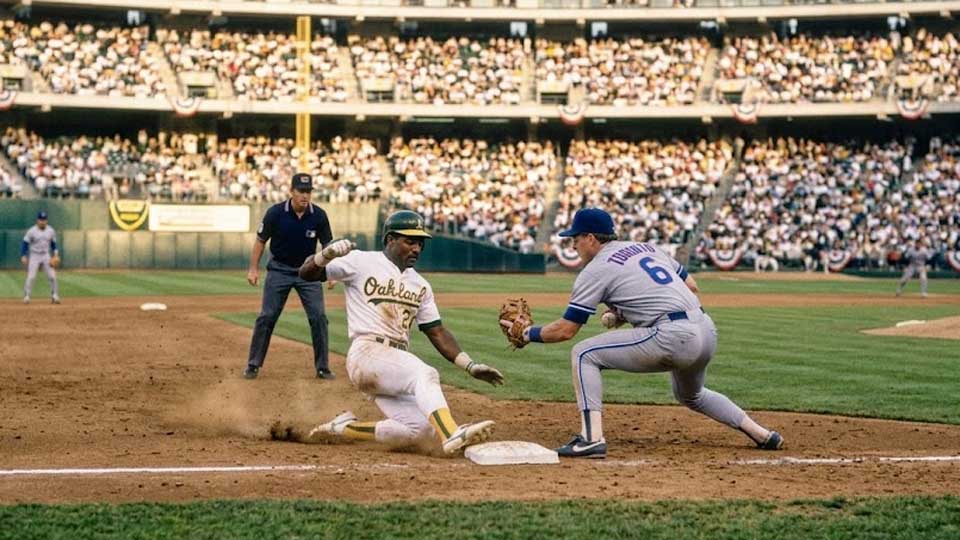
Using TriSync Sports With The Stolen Base Strategy: How to Exploit Baseball's Most Predictable DFS Scoring Category
In the modern era of baseball analytics, stolen bases have become something of a lost art. Teams don't run like they used to. The days of Rickey Henderson swiping 130 bases in a season are long gone. Even 50-steal seasons are rare.
But in daily fantasy sports? Number of stolen bases remains one of the most exploitable edges available.
Here's why: While home runs are unpredictable (a hitter with 30 HR potential might go deep twice one night and then none for a week), stolen bases follow patterns. They have matchup indicators. They correlate with specific game situations. And most importantly, they're significantly undervalued by the DFS pricing algorithms and the casual public.
When you roster a player like Elly De La Cruz on a night when the Reds are facing a catcher with a 2.1-second pop time and a pitcher who takes 1.8 seconds to deliver to the plate, you're not hoping for magic. You're making a calculated bet based on measurable defensive inefficiencies. And when that steal happens (worth five to six fantasy points depending on the site), you've just gained an edge that most of your competition completely ignored.
The Stolen Base Strategy isn't about building entire lineups around speedsters. It's about understanding when and how to incorporate high-steal-probability players into your lineups to create a scoring dimension that your opponents are overlooking. Let's break down exactly how to identify steal opportunities, which players to target, when to deploy this strategy, and how to maximize the points-per-dollar value that stolen bases provide.
Resources other than just the TriSync system may be needed to use this strategy to the fullest, but the time and energy you save by using the TriSync system, allows you the freedom to explore other resources, when needed.
Why Stolen Bases Matter in DFS
The Scoring Premium
DraftKings scoring:
- Stolen base: 5 points
- Single: 3 points
- Run scored: 2 points
- RBI: 2 points
FanDuel scoring:
- Stolen base: 6 points
- Single: 3 points
- Run scored: 3.2 points
- RBI: 3.5 points
The key insight:
On DraftKings, a stolen base is worth 1.67 singles or 2.5 runs scored.
On FanDuel, a stolen base is worth 2.0 singles or 1.7 RBIs.
What this means strategically:
A leadoff hitter who goes 1-for-4 with a walk, a run scored, and two stolen bases:
DraftKings:
- 1 single: 3 points
- 1 walk: 2 points
- 1 run: 2 points
- 2 steals: 10 points
- Total: 17 points
FanDuel:
- 1 single: 3 points
- 1 walk: 2 points
- 1 run: 3.2 points
- 2 steals: 12 points
- Total: 20.2 points
Compare to a power hitter who goes 1-for-4 with a solo home run:
DraftKings:
- 1 home run: 10 points
- 1 run: 2 points
- 1 RBI: 2 points
- Total: 14 points
FanDuel:
- 1 home run: 12 points
- 1 run: 3.2 points
- 1 RBI: 3.5 points
- Total: 18.7 points
The speedster outscored the power hitter on both sites, despite the power hitter hitting a home run.
The Pricing Inefficiency
The market inefficiency:
DFS pricing algorithms heavily weight home run potential and RBI production. Players with 30+ HR power get priced at $5,500-$6,500.
Players with 30+ steal potential often get priced at $4,200-$5,000 unless they also have power.
Examples of speed and power:
- Elly De La Cruz (40+ steal potential, elite speed): $5,200-$5,800
- Bobby Witt Jr. (40+ steals, elite all-around): $5,800-$6,300
- Corbin Carroll (30+ steals, bats 3rd, speed + power): $5,000-$5,700
Examples of underpriced speed:
- Jose Caballero (50+ steals, bats 8th): $3,100-$3,600
- Chandler Simpson (50+ steals, leadoff, BA .282): $3,000-$3,500
Compare to below top-tier power hitters:
- Kyle Schwarber (50+ HR, a couple of steals): $5,300-$6,000
- Pete Alonso (35+ HR, zero speed): $5,000-$5,800
The edge:
Both player types can produce 15-20 point games. But the speedster gets there with two hits + two steals (very achievable in the right matchup), while the power hitter needs a multi-hit game or a home run.
The speedster's production is more predictable when you can identify favorable steal matchups.
The Stacking Multiplier
When you stack speed with other factors:
Speed + Leadoff position, creates maximum steal opportunities (4-5 times on base)
Speed + Hitter-friendly park, creates more hits, leading to more steal chances
Speed + Weak catcher or weak pitcher, especially if Composite score for either or both < 1.95
Speed + Team strategy of the manager giving players the green light to steal
Speed + Composite score >= 3.75 + Capacity >= 5.0 + at least three steals in last seven days, leads to all signs pointing to a potential big stolen base total
Identifying High-Steal Players
The Tier System
Tier 1: Elite Multi-Category Speedsters (30+ steals + power)
These players combine speed with other fantasy production. They're expensive but worth it in the right spots.
Examples:
- Bobby Witt Jr. (Royals): 40+ steals and 25+ HR potential
- Elly De La Cruz (Reds): 60+ steal potential and emerging power
- Trea Turner (Phillies): 25+ steals and solid all-around stats
When to roster:
- Any favorable matchup (they produce multiple ways)
- Cash games (elite floor + ceiling)
- GPPs (lower-owned than you'd think despite being stars)
Typical pricing: $4,900-$6,200 (DraftKings)

Tier 2: Speed-First Players (40+ steal potential)
These players are built for speed but limited in other categories. Their fantasy value is heavily steal-dependent.
Examples:
- Corbin Carroll (Diamondbacks): 40+ steals, improving power
- Jazz Chisholm Jr. (Yankees): 40+ steals, 20+ home run power
- Julio Rodríguez (Mariners): 20+ steals, 25+ home runs
When to roster:
- Specific matchup advantage (weak catcher, slow pitcher)
- FanDuel especially (6 points per steal)
- GPPs when low-owned
- Stacked with team when facing a Suboptimal pitcher
- Composite score >= 3.75
Typical pricing: $4,000-$5,000
Tier 3: Secondary Speedsters (15-25 steals)
These players aren't pure speedsters but have enough wheels to contribute steals in favorable spots.
Examples:
- Jackson Merrill (Padres): 10-30 steals, bats 2nd, home runs, runs and rbis
- Bryon Stott (Phillies): 10-20 steals, bats 6th
When to roster:
- Cash games (safe floor, steal potential is bonus)
- When you need occasional steal from lower in the order
- Priced for their other skills, steals are value-add
- Composite score >= 3.75
Typical pricing: $3,800-$4,400
Tier 4: Situational Speedsters (Platoon/Bench players with speed)
These players don't play every day but have elite speed when they do. Often mispriced.
Examples:
- Bench players getting starts against specific pitchers
- Platoon players who only face one handedness
- Rookies just called up (pricing hasn't adjusted)
When to roster:
- Confirmed in lineup batting 1st-3rd
- Minimum salary or near-minimum
- GPPs only (too risky for cash)
- When stacking their team anyway
- Speed + Composite score >= 3.75 + Capacity score >= 5.0
Typical pricing: $2,500-$3,500
The Statistical Profile
What to look for when evaluating steal potential:
✅ Stolen base success rate
- Elite: 85%+ (manager will give the green light)
- Good: 75-84% (solid)
- Poor: Under 70% (manager restricts, less opportunity)
✅ Stolen base attempts per game
- Elite: 0.25+ SB attempts per game (40+ per season)
- Good: 0.15-0.24 (24-40 per season)
- Limited: Under 0.15 (under 24 per season)
✅ Times on base per game
- More on-base = more steal chances
- Target .340+ OBP minimum
✅ Team philosophy
- Some teams run aggressively (Reds, Rays historically)
- Some teams never run (risk-averse managers)
- Check team stolen base totals league-wide as the season progresses
Where to find this data:
- FanGraphs (SB success rate, attempts)
- Baseball Reference (team stolen base totals)
Matchup Indicators: When Steals Are Most Likely
Catcher Pop Time (The #1 Indicator)
Pop time definition: Time from when the pitch hits the catcher's glove to when the throw reaches second base.
League average: ~2.0 seconds
Elite catchers (steal deterrents):
- Under 1.90 seconds: Adley Rutschman, J.T. Realmuto, others
- These guys gun down runners consistently
- Avoid steal plays against them
Poor catchers (steal opportunities):
- 2.05+ seconds: Several backup catchers, some regulars
- Gives runners extra step to second base
- Target steal plays against them
Where to find pop time data:
- Baseball Savant (Catcher Pop Time leaderboard)
- Updated weekly during season
Rule of thumb:
Target speedsters facing catchers with 2.00+ pop time. Fade speedsters facing catchers under 1.92 pop time.
Pitcher Delivery Time
Why it matters:
Even if the catcher has a good arm, a slow-delivering pitcher gives runners extra time to get a jump.
Delivery time: Time from pitcher's first move to ball hitting catcher's glove
League average: ~1.3-1.4 seconds (from stretch position)
Slow pitchers (steal opportunities):
- 1.5+ seconds to the plate
- Often older pitchers, crafty lefties with big leg kicks
- Gives runners 2-3 extra feet
Quick pitchers (steal deterrents):
- Under 1.2 seconds
- Often pitchers with slide-step or simplified deliveries
- Reduces steal success significantly
Where to find this data:
- Baseball Savant (limited)
- Pitcher scouting reports
- Video analysis
Game Script Considerations
When teams are MORE likely to steal:
✅ Close games (tied or within 2 runs)
- Manufactured runs matter
- Managers more aggressive
- Players get green light
✅ Early innings (1st-6th)
- Don't want to make outs on basepaths late
- More conservative in 8th-9th innings
✅ Team trailing by 1-2 runs
- Need to manufacture offense
- Willing to take risks
✅ Runner on first, nobody out
- Classic steal situation
- Gets runner into scoring position
✅ Fast runner, slow hitter behind him
- Manager wants to avoid double play
- Steal attempt gets runner out of DP range
When teams are LESS likely to steal:
❌ Blowout games (5+ run differential)
- No need to manufacture runs
- Don't risk injury
❌ Big power hitter at the plate
- Don't want to take bat out of his hands with stolen base attempt
- Let him swing
❌ Two outs
- Runner scores on most hits anyway
- Not worth the risk
DFS application:
Check Vegas totals and game script projections. Close, competitive games (8.5-9.5 total runs) typically produce more steal attempts than blowouts (12+ total runs).
Weather and Field Conditions
Warm weather = more steals
- Warmer temps = harder dirt = faster base paths
- Players looser, more athletic
- 75°F+ optimal
Cold weather = fewer steals
- Stiff, cold muscles
- Slower reaction times
- Sub-60°F reduces steal attempts
Dry conditions = more steals
- Firm basepaths
- Better footing
Wet conditions = fewer steals
- Slippery bases
- Higher injury risk
- Catchers have better blocking angles on wet grass
DFS application:
Check weather two to three hours before first pitch. If conditions are ideal (80°F+, dry, no wind), boost your speed exposure. If cold/wet, reduce it.
Umpire Behind the Plate
Strike zone matters for speedsters:
Tight strike zone umpire (fewer strikes called):
- More walks = speedsters get on base more
- More pitch counts = pitchers tired later (slower deliveries)
- More steal opportunities
Wide strike zone umpire (more strikes called):
- Fewer walks = speedsters on base less
- Quicker at-bats = fewer chances
Where to find umpire data:
- UmpScorecards.com (daily umpire assignments)
- Historical strike zone tendencies
DFS application:
If a notoriously tight-zone umpire is behind the plate, slightly boost speedsters (more walks = more steal chances).
When to Deploy the Stolen Base Strategy
Primary Use Case: FanDuel Cash Games
Why FanDuel specifically:
Stolen bases are worth 6 points on FanDuel vs. 5 on DraftKings. That 20% premium makes speed even more valuable.
The strategy:
Build lineups with three or four players who have 20+ steal potential. In favorable matchups, you might get 6-10 total stolen bases across your lineup.
Expected scoring:
- 8 steals × 6 points = 48 points from steals alone
- Add hits, runs, RBI = 140+ point lineup
Sample FanDuel cash game, core:
- Elly De La Cruz (60+ steal pace)
- Bobby Witt Jr. (30+ steals)
- Chandler Simpson (40+ steals)
- Corbin Carroll (25+ steals)
If each gets 1 steal: 4 steals × 6 = 24 points just from speed
If they average 1.5 steals: 6 steals × 6 = 36 points from speed
That's 10-15% of your total lineup score from ONE category.
Secondary Use Case: DraftKings GPP Differentiation
The leverage play:
Most DFS players stack power. They want home runs, RBIs, slugging.
By rostering high-steal players in GPPs, you create a different scoring path that your opponents don't have.
Example:
The field's approach: Stack Yankees cleanup/5th/6th hitters (power, RBIs)
Your contrarian approach: Stack Reds 1-2-3 hitters, with speed emphasis (Elly De La Cruz, other speedsters)
If Reds manufacture 6 runs with small ball, steals, aggressive baserunning, and Yankees score 8 runs but with just power, you might outscore them due to:
- More plate appearances (top-of-order)
- More steals (six to eight steals vs. zero or one steal)
- More runs scored (more guys on base)
Your unique scoring composition creates differentiation.
Tertiary Use Case: Daily Double Strategy
The concept:
When a speedster is in an elite matchup, pair him with a teammate for correlation, especially leadoff and 3rd.
Example:
Elly De La Cruz (Reds’ leadoff) + Spencer Steer (Reds’ 2nd hitter, sometimes 4th)
The correlation:
- De La Cruz gets on base, steals second
- Steer drives him in with single
- De La Cruz scores (2 points), Steer gets RBI (2 points)
- De La Cruz already got steal (5 points) + hit (3 points)
Total from sequence: 12-15 points from two players executing small-ball
This happens multiple times per game when you stack speed + contact hitters.
Building Stolen Base Focused Lineups
Strategy 1: The Contrarian Speed Stack (DraftKings GPP)
Core philosophy: Stack an under-owned team with speed emphasis for GPP differentiation.
DraftKings $50,000 sample build:
SP1: Kyle Bradish ($9,000) Orioles vs Red Sox
- Other team has most hitters at a Fair level, different game
SP2: Walbert Urena ($8,600) - Cardinals vs. Angels
- Safe matchup, different game
C: Tyler Stephenson ($3,000) – Reds, bats 6th
- Punt catcher from Reds’ stack
1B: Munetaka Murakami ($5,100) - White Sox
- Different game, power balance
2B: Ben Williamson ($3,100) - Rays, 7th spot
- Value play from different game
3B: Austin Riley ($4,000) - Braves
- Different game, value play with a 7.11 Composite score
SS: Elly De La Cruz ($5,200) – Leadoff for Reds, 60+ steal potential
- Speed stack anchor
OF: TJ Friedl ($2,900) - Reds, bats 8th, minor speed element
- Reds stack piece
OF: Spencer Steer ($4,400) - Reds, bats 4th
- Reds stack piece, drives in De La Cruz, 10+ steal potential
OF: JJ Bleday ($4,100) - Reds, speed + power, bats 3rd
- Reds stack piece, 10+ steal potential
Total: $49,400
Strategy:
- Five-man Cincinnati Reds lineup speed stack (likely 12-18% owned)
- Facing backup catcher with 2.05 pop time
- Reds expected to run wild
- If Reds score 7+ runs with four to six steals, elite GPP leverage
Strategy 2: The Daily Double Mini-Stack
Core philosophy: Pair leadoff with at least some speed, with his team's #3 hitter for correlation.
DraftKings $50,000 sample build:
SP1: Walbert Urena ($8,600) - Reds vs Mariners
- Elite arm, different game
SP2: Tyler Phillips ($6,000) - Marlins vs Astros
- Facing a vulnerable, Developing pitcher, different game
C: Gabriel Moreno ($4,200) - Dbacks
- Solid bat, power
1B: Michael Busch ($4,100) – Cubs, batting 3rd
- Daily double with Crow-Armstrong
2B: Nico Hoerner ($3,500) – Cubs, 6th, 25+ steals
- Solid stats, steal threat
- Stacks with Cubs daily double
3B: Manny Machado ($4,500) - Padres, bats 3rd
- Daily double with Tatis Jr.
SS: Jose Caballero ($3,500) – Yankees, 8th, 50+ steals
- Value punt, steal threat
OF: Pete Crow-Armstrong ($6,500) – Cubs’ leadoff
- Daily double with Busch
OF: Fernando Tatis Jr. ($5,500) - Padres, leadoff
- Daily double with Machado
OF: Chandler Simpson ($3,400) – Rays, 60+ steal potential
- Standalone speedster, different game
Total: $49,800
Daily doubles:
- Tatis Jr. (speed/leadoff) + Machado (drives him in)
- Crow-Armstrong (speed/leadoff) + Busch (drives him in)
Correlation:
- Tatis Jr. gets on base, Machado drives him in
- Crow-Armstrong walks, Busch drives him in
- Multiple pathways to scoring, as leadoff hitters also have power
- Elite cash game construction
Advanced Stolen Base Tactics
The Late-Inning Steal Scenario
The situation:
It's the 7th inning, close game (tied or 1-run game). Your speedster is on first base.
Why this matters:
Managers become more aggressive in close games late. They WANT to get that runner into scoring position.
DFS application:
Games projected to be close, typically produce more late-game steals. Target speedsters in competitive matchups, not blowout spots.
The "Pitcher Can't Hold Runners" Exploit
Some pitchers are terrible at holding runners:
Check "stolen bases allowed" stats for starting pitchers.
Red flags (good for speedsters):
- Pitcher allows 15+ steals per season
- Pitcher has pickoff rate under 2%
- Pitcher rarely throws to first (doesn't care about runners)
Where to find:
- Baseball Reference (pitcher page → fielding stats)
- FanGraphs (pitcher advanced stats)
Example pitchers who historically struggle:
- Tall pitchers with big leg kicks
- Older pitchers who lost agility
- Rookies still learning to hold runners
DFS application:
If your speedster is facing a pitcher who allowed 20+ steals last season, boost exposure. The pitcher simply can't control the running game.
The Rookie Catcher Exploitation
Rookie catchers are DFS gold for speedsters:
First-year catchers often have:
- Inconsistent throwing mechanics
- Poor pitch framing (more passed balls = free bases)
- Lack of game management experience
- Slower pop times
How to identify:
Check if opposing catcher is:
- In first 100 MLB games
- Has pop time over 2.05 seconds
- Has caught stealing rate under 25%
DFS application:
When a veteran speedster faces a rookie catcher, it's target practice. Expect 1-3 steal attempts with 80%+ success.
The Desperation Steal (Team Trailing)
Game script consideration:
When a team is trailing by one or two runs in innings 6-9, they become desperate. They'll send runners more aggressively.
The analytics:
Teams trailing by 1 run in 7th-9th innings:
- Steal attempts increase by 30%
- Even non-speedsters will run
DFS application:
If your speedster's team is projected to lose (underdog by 1-1.5 runs), they might attempt steals even in situations with a lower expected success rate.
Common Stolen Base Strategy Mistakes
Mistake #1: Ignoring the Catcher
The trap:
"Elly De La Cruz is fast, so I'm rostering him!"
He's facing J.T. Realmuto (1.89 pop time, elite arm). De La Cruz tries to steal, gets thrown out. Zero points, wasted opportunity.
The problem:
Speed alone isn't enough. The defensive matchup matters enormously.
The fix:
ALWAYS check the opposing catcher's pop time before rostering speedsters.
Use Baseball Savant catcher leaderboard. If pop time is under 1.95 seconds, reduce speedster exposure significantly.
Mistake #2: Rostering Speed in Blowout Games
The trap:
You roster speedsters in a game projected at 12.5 total runs (likely blowout).
Yankees projected to beat Athletics 9-3.
The problem:
In blowouts, teams don't steal. No need to manufacture runs. Managers pull starters early. No steal opportunities materialize.
The fix:
Target speedsters in competitive games (8.5-10 run totals), not blowouts.
Close games = more steal attempts Blowouts = conservative play
Mistake #3: Overloading on Pure Speed (No On-Base Skills)
The trap:
You roster three speedsters who hit .220 with .280 OBP.
They're fast, but they're not getting on base. Can't steal if you're not on base.
The problem:
Speed without on-base ability is useless.
The fix:
Target speedsters with .330+ OBP minimum.
Good speed play: Elly De La Cruz (.336 OBP, elite speed) Bad speed play: Backup outfielder (.260 OBP, good speed)
First guy gets on base 2-3 times, steals twice. Second guy gets on base 0-1 times, steals zero.
Mistake #4: Ignoring Lineup Position
The trap:
Your speedster is batting 7th in the order today (moved down for platoon reasons).
He'll get 3.2 plate appearances instead of 4.5.
The problem:
Fewer PAs = fewer times on base = fewer steal opportunities.
The fix:
Mostly roster speedsters batting 1st-3rd in the order. Lower in the order only OK for value plays needed to fit into the available budget.
If your speedster dropped to 6th-7th, pivot to someone else. The PA volume advantage is gone.
Mistake #5: Chasing Yesterday's Steals
The trap:
Player X stole three bases last night. You assume he'll do it again today.
The problem:
Stolen bases cluster randomly. A player might steal three one night, then go a week without attempting one.
The fix:
Evaluate TODAY's matchup independently:
- Is today's catcher weak-armed?
- Is today's pitcher slow to the plate?
- Is game script favorable?
- Does player have a Composite score >= 3.75?
If no, don't roster just because of yesterday's stats.
Mistake #6: Forgetting About Team Philosophy
The trap:
You roster a player with elite speed on a team that never runs.
Manager is old-school, doesn't believe in stealing. Team has 40 total steals all season.
The problem:
Player ability doesn't matter if the manager won't green light steals.
The fix:
Check team stolen base totals.
Teams with 120+ steals: Aggressive, will run Teams with under 60 steals: Conservative, won't run
Target speedsters on teams that actually steal.
Mistake #7: Not Checking Injury Reports
The trap:
Your speedster has a minor hamstring issue (day-to-day).
He's in the lineup but at 80%. Manager won't let him run.
The problem:
Injured speedsters don't get the green light to steal, even if they play.
The fix:
Check injury reports one to two hours before first pitch.
If your speedster has ANY lower-body injury (hamstring, quad, ankle), reduce steal expectations by 50%.
Multi-Entry Speed Strategy
Portfolio Approach (20-Lineup GPP Entry)
Concept: Create exposure across different speed levels.
Allocation:
6 lineups: Max speed (4+ speedsters)
- All-in on stolen bases
- Hope for 8-12 total steals
- High variance, high ceiling
8 lineups: Moderate speed (2-3 speedsters)
- Balanced approach
- Hope for 3-6 total steals
- Medium variance
6 lineups: Minimal speed (0-1 speedsters)
- Power-focused
- Traditional DFS construction
- Lower variance
Why this works:
You're covered for multiple slate outcomes:
- Speed-heavy slate (max speed lineups crush)
- Balanced slate (moderate lineups cash)
- Power-heavy slate (minimal speed lineups survive)
The Staggered Speed Stacks
Concept: Vary WHICH speedsters you roster across lineups.
Lineups 1-5:
- Elly De La Cruz + Bobby Witt Jr.
Lineups 6-10:
- Elly De La Cruz + Crow-Armstrong
Lineups 11-15:
- Pete Crow-Armstrong + Bobby Witt Jr.
Lineups 16-20:
- All three (Crow-Armstrong + De La Cruz + Witt Jr.)
Why this works:
If De La Cruz goes off, your first ten lineups, hit. If Witt Jr. has the big night, different subset hits. If all three perform, your last five lineups spike.
You're diversified across elite speed options.
Site-Specific Considerations
FanDuel: Maximum Speed Emphasis
Why FanDuel favors speed:
- 6 points per steal (vs. DK's 5)
- Higher scoring for runs (3.2 vs. DK's 2)
- Speedsters who score runs + steal = huge value
FanDuel strategy:
Roster three to five speedsters per lineup in cash games.
Target: 6-10 total steals across lineup Expected: 36-60 points from steals alone
Sample FanDuel core:
- Elly De La Cruz
- Bobby Witt Jr.
- Trea Turner
- Corbin Carroll
If each player averages 1 steal: 5 steals × 6 = 30 points If each speedster averages 1.5 steals: 7.5 steals × 6 = 45 points
That's 20-30% of your total lineup score from one category.
DraftKings: Selective Speed Integration
Why DraftKings is less speed-focused:
- 5 points per steal (still good, but 17% less than FanDuel)
- Run scoring worth less (2 points vs. FD's 3.2)
DraftKings strategy:
Roster one to three speedsters per lineup.
Use speed as:
- Differentiation in GPPs (contrarian angle)
- Floor-raiser in cash (adds consistency)
- Correlation piece with power bats
Sample DK integration:
Don't build entire lineup around speed.
Instead
- One or two elite speedsters (Crow-Armstrong, De La Cruz)
- Three or four power/contact bats
- Two or three balanced all-around players
Expected: 3-5 steals per lineup (15-25 points from steals)
Final Thoughts: The Math Doesn't Lie
The Stolen Base Strategy isn't about hoping players randomly swipe bags.
It's about identifying measurable defensive inefficiencies:
- Catchers with 2.05+ pop times
- Pitchers with 1.5+ delivery times
- Teams with 30%+ stolen base success rates allowed
- Game scripts that encourage running
- Speedsters versus pitchers or catchers with Composite score for either or both < 1.95
When you combine elite speedsters with favorable matchups, stolen bases become one of the most predictable scoring categories in DFS baseball.
The edge:
Most DFS players ignore steals completely. They stack power, they chase home runs, they roster cleanup hitters.
By incorporating two to four high-steal players into your lineups, especially on FanDuel where steals are worth 6 points, you're creating a scoring dimension that 70-80% of the field doesn't have.
The consistency:
A player with 40-steal potential will deliver steals in roughly 25-30% of his games. That's more consistent than home run hitters (who go deep in maybe 12-15% of games).
When you identify the RIGHT matchup (weak catcher, slow pitcher, competitive game), that 25-30% jumps to 40-50%.
Start here:
- Check catcher pop times on Baseball Savant
- Identify three to five elite speedsters on the slate
- Filter for favorable matchups (pop time 2.0+, competitive game)
- Roster two to three speedsters in cash games, one to four in GPPs
- Track results over 50+ slates
Over time, you'll notice your lineups consistently outpace the field by 10-15 points from steals alone.
That's the difference between cashing and missing.
Remember:
You can't steal first base. But once your speedster gets on, and you've done the matchup homework, and the catcher has a 2.10 pop time, and the pitcher is slow to the plate?
That's not luck. That's math.
And in DFS, math wins.
Check the pop times. Target the matchups. Roster the speed.
Cash your tickets.
Repeat.
Bet responsibly. Past performance of any analytical system does not guarantee future results. TriSync Sports is intended as an informational and entertainment tool.