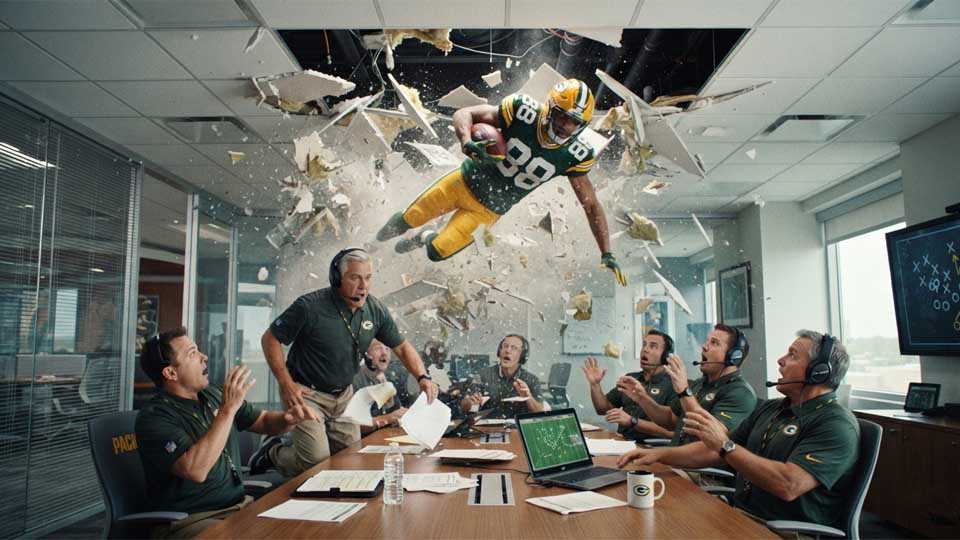
Using TriSync Sports to Find Wide Receivers With Tournament-Winning Upside
Running back DFS strategy often begins with:
VOLUME.
How many carries?
How many targets?
How many total opportunities?
Wide receiver is different.
Targets still matter.
A lot.
But in a large GPP tournament, we aren't simply searching for receivers who will catch a few passes.
We're searching for receivers capable of producing:
A SLATE-CHANGING SCORE.
Eight catches.
130 yards.
Two touchdowns.
Maybe even more.
One explosive wide receiver performance can completely change an NFL DFS tournament.
That's why this strategy focuses on:
CEILING.
And TriSync gives us several tools for identifying where that ceiling may be hiding.
Welcome to the:
TriSync Sports WR Ceiling Strategy.
What Do We Mean by Ceiling?
A player's ceiling represents the upper end of the fantasy production we believe he can reasonably deliver.
For this strategy, one of our most important TriSync measurements is:
Points Max helps us see the higher end of a player's projected scoring range.
That's especially important in:
GPP TOURNAMENTS.
Cash contests reward consistency.
Large tournaments reward:
EXCEPTIONAL SCORES.
We're trying to find receivers capable of producing them.
Start With Hi Variance
Because this strategy is designed primarily for GPPs, begin with:
VARIANCE = HI.
We're willing to accept additional uncertainty in exchange for greater potential upside.
That's the nature of tournament DFS.
We aren't necessarily asking:
Which WR is least likely to disappoint?
We're asking:
Which WR can help us reach the top of the tournament if he hits?
That's a very different question.
Wide Receiver Is Naturally a Ceiling Position
Why does this strategy work particularly well at WR?
Because one play can be enormous.
Imagine a receiver catches a:
70-YARD TOUCHDOWN.
That's immediately a major fantasy event.
Now add:
Several other receptions.
More receiving yards.
Maybe another touchdown.
Suddenly the receiver has produced:
30+ FANTASY POINTS.
And it can happen quickly.
That's why WR can become one of the most important positions for finding GPP ceiling.
Targets Are the Foundation
Before chasing ceiling, start with:
TARGETS.
A receiver needs the football.
More targets generally create more opportunities for:
Receptions
Receiving yards
Touchdowns
and
bonuses.
A receiver regularly seeing:
9-12 targets
has more opportunities than someone receiving:
3-4.
But just like carries with running backs:
Not all targets are equal.
Target Quality Matters
Imagine:
WR A
10 targets.
Mostly short passes near the line of scrimmage.
WR B
8 targets.
Several downfield opportunities plus red-zone work.
Who has the greater ceiling?
It may be:
WR B.
WR A may offer the stronger reception floor.
WR B may offer more opportunities to create:
EXPLOSIVE FANTASY EVENTS.
That's why we need to look beyond raw target totals.
Downfield Targets Create Ceiling
A deep target can turn into:
40 YARDS.
50 YARDS.
70 YARDS.
And potentially:
A TOUCHDOWN.
One successful downfield connection can produce the fantasy equivalent of several short receptions.
That's why receivers who consistently receive deep opportunities deserve attention in GPPs.
Especially when TriSync supports the player's expected performance.
Red-Zone Targets Create Another Path
Deep targets aren't the only way to create ceiling.
Red-zone usage is enormously important.
A receiver may not be a classic deep threat.
But if his quarterback consistently looks for him near the goal line?
He has access to:
TOUCHDOWNS.
And touchdowns create ceiling.
A receiver who combines:
High target volume
with
red-zone opportunity
can become particularly attractive.
The Best Ceiling Receivers Have Multiple Paths
Ideally, we want receivers who can produce through several methods.
They can:
Catch eight or more passes.
Break a long play.
Accumulate 100+ yards.
Score from distance.
Score in the red zone.
Catch multiple touchdowns.
That gives us:
MULTIPLE PATHS TO A BIG SCORE.
The more ways a receiver can reach his ceiling, the more interesting he becomes.
The 100-Yard Bonus Matters
DraftKings rewards a receiver for reaching:
100 RECEIVING YARDS.
That creates another important ceiling threshold.
A receiver who finishes with:
8 catches
105 yards
and
1 touchdown
hasn't simply produced receptions and yardage.
He's also crossed an important bonus threshold.
For GPP construction, receivers with legitimate:
100-YARD POTENTIAL
deserve additional attention.
Now Bring in Points Max
This is where TriSync becomes extremely useful.
Start examining WRs through:
POINTS MAX.
We're looking for players whose projected scoring ranges provide access to:
TOURNAMENT-WINNING SCORES.
Suppose:
WR A
Points Max: 25
WR B
Points Max: 37
WR C
Points Max: 41
For a GPP, WR B and WR C immediately deserve attention.
But we're not finished.
Points Max identifies the ceiling.
Now we need to determine:
HOW ATTRACTIVE THAT CEILING IS.
Combine Points Max With TriSync Value Projection
This may be the heart of the strategy.
We don't simply want:
HIGH CEILING.
We want:
HIGH CEILING AT THE RIGHT PRICE.
Suppose:
WR A
Salary: $8,400
Points Max: 39
TriSync Value Projection: 2.45
WR B
Salary: $6,300
Points Max: 36
TriSync Value Projection: 3.25
WR A has the slightly higher ceiling.
But WR B gives us:
Nearly the same Points Max.
A stronger TriSync Value Projection.
And:
$2,100 IN SALARY SAVINGS.
That makes WR B extremely interesting.
What Does the Salary Difference Buy?
Always ask this question.
WR B saves:
$2,100.
Maybe that upgrades:
RB2.
TE.
FLEX.
D/ST.
Or even QB.
So the real comparison isn't:
WR A vs. WR B.
It's:
WR A + whatever we can afford elsewhere
versus:
WR B + the upgraded player his salary makes possible.
That's DFS lineup construction.
High Ceiling + Value Is the Sweet Spot
One of the strongest WR combinations we can find is:
HIGH POINTS MAX
plus
HIGH TRISYNC VALUE PROJECTION.
Now we're getting:
Tournament upside.
Attractive salary efficiency.
And potentially enough savings to improve another roster position.
That's exactly the kind of receiver we want to identify.
Use TriSync Projection Too
TriSync Projection remains important.
It helps us understand the player's expected performance level.
Think of the measurements this way:
TriSync Projection = Expected Performance.
TriSync Value Projection = DFS Opportunity for the Salary.
Points Max = Upper-End Scoring Potential.
For WR Ceiling Strategy, we want these measurements working together.
A receiver with:
Strong TriSync Projection.
Strong Value Projection.
And large Points Max
should immediately get our attention.
Lineup Signal Adds Another Layer
Now examine:
LINEUP SIGNAL.
For GPP receivers, we're especially interested in:
Core
Premium
Value+
and
Value.
Imagine a receiver with:
Large Points Max.
Strong Value Projection.
And:
VALUE+.
That's a very attractive combination.
Or maybe an expensive superstar carries:
PREMIUM
with one of the largest Points Max numbers on the slate.
He may be worth paying for.
The Lineup Signal helps us understand how the player fits the DFS landscape.
Output Level Gives Us Performance Context
Now look at:
OUTPUT LEVEL.
Excellent.
Good.
Fair.
Suboptimal.
Suppose a WR has:
Large Points Max.
Strong Value Projection.
Value+ signal.
And an:
EXCELLENT
Output Level.
That's multiple indicators pointing toward upside.
This is exactly the type of combination we're searching for.
Don't Automatically Eliminate Fair
Just like our other strategies, we don't want one measurement making the entire decision.
Suppose a superstar receiver is currently:
Fair.
But he still carries:
A strong TriSync Projection.
A huge Points Max.
Heavy target volume.
Red-zone work.
And explosive-play potential.
He's still capable of producing a tournament-winning score.
Output Level provides context.
It shouldn't automatically override everything else.
Secondary + Aligned + Good Can Be Great
A Lineup Signal of Secondary for a player with an Aligned profile, in a Good window can often be a strong producer, especially at an attractive price.
Suppose a receiver is currently:
Good.
But he still carries:
An Aligned Profile
A strong TriSync Projection.
An adequate Points Max.
An affordable salary.
He's still capable of producing a score that will help win a tournament due to his salary.
Using this receiver may make it affordable to roster a top receiver.
Output Level provides context.
It shouldn't automatically override everything else.
Excellent Isn't Enough Without Opportunity
The reverse is also true.
A receiver may be in an:
Excellent
Output Level.
But he's receiving:
Three targets per game.
He's the fifth option in the offense.
His Points Max is limited.
That's not necessarily the ceiling profile we're looking for.
TriSync conditions can be favorable.
But the receiver still needs:
OPPORTUNITY.
The Ideal WR Ceiling Profile
If we could design the perfect GPP receiver, we'd want:
Heavy targets
Downfield opportunity
Red-zone targets
100-yard potential
Multi-touchdown potential
Strong TriSync Projection
High TriSync Value Projection
Large Points Max
Core, Premium, Value+ or Value Lineup Signal
Excellent or Good Output Level
and
a reasonable salary.
We won't find all of those every week.
We're searching for the best combinations.
WR1 Isn't Automatically the Best Ceiling Play
This is important.
The team's WR1 may be:
The biggest name.
The highest-paid receiver.
And the most expensive DFS option.
But that doesn't automatically make him the best tournament selection.
Maybe WR2 has:
A lower salary.
Strong Value Projection.
Large Points Max.
Excellent Output Level.
And legitimate deep-ball or touchdown opportunity.
Now we have another way to access the offense.
Possibly at:
A MUCH BETTER PRICE.
WR2 Can Be a GPP Weapon
Suppose:
WR1
Salary: $8,100
Points Max: 38
Value Projection: 2.60
WR2
Salary: $5,700
Points Max: 34
Value Projection: 3.20
We're giving up:
4 points of projected maximum.
But saving:
$2,400.
That's substantial.
If WR2 reaches his ceiling, we now have additional salary available to create ceiling elsewhere.
That's how GPP lineups become dangerous.
Don't Forget WR3
Occasionally, a team's third receiver can become interesting.
Especially when he has:
A meaningful role.
Deep targets.
Red-zone opportunities.
A salary discount.
And strong TriSync support.
We're not trying to predict random touchdowns.
We're searching for:
LOW-COST ACCESS TO REAL CEILING.
If WR3 needs one lucky 70-yard touchdown to become useful, that's fragile.
If he receives six targets with legitimate downfield work?
That's different.
Air-Yard Opportunity Can Reveal Upside
Not every target travels the same distance.
A receiver receiving short targets may accumulate receptions.
A receiver receiving deeper targets can accumulate yardage much faster.
That's why downfield opportunity matters.
We're looking for receivers who can turn:
ONE CATCH
into a major fantasy event.
That's extremely valuable in tournaments.
Quarterback Quality Matters
Wide receivers don't throw themselves the football.
Their ceiling is partially connected to:
QUARTERBACK PERFORMANCE.
That's where TriSync gives us another useful angle.
How does the QB look?
Strong TriSync Projection?
Strong Value Projection?
Favorable Output Level?
Large Points Max?
If both the QB and WR carry strong TriSync outlooks.
That's significant.
Their ceilings are connected.
This Is Why QB Stacking Works
Suppose the WR produces:
9 receptions
145 yards
and
2 touchdowns.
What probably happened to his quarterback?
He likely accumulated:
Passing yards.
Passing touchdowns.
And fantasy points from the same plays.
That's why:
QB + WR
is such a natural GPP combination.
The receiver's ceiling can help create:
THE QUARTERBACK'S CEILING TOO.
Start With the Receiver Sometimes
We usually think:
Choose QB.
Then find his receiver.
WR Ceiling Strategy can reverse that.
Suppose TriSync identifies a receiver with:
One of the highest Points Max numbers on the slate.
Strong Value Projection.
Excellent Output Level.
And Value+ signal.
Start with:
THE RECEIVER.
Then examine his quarterback.
If the QB also rates well?
Now we've discovered the stack from the other direction.
That's perfectly valid.
Double Stacks Can Capture More Ceiling
Suppose a quarterback has two pass catchers with:
Strong TriSync Value Projections.
Large Points Max numbers.
And attractive Lineup Signals.
Now:
QB + WR + WR
or:
QB + WR + TE
may become interesting.
If the offense produces:
Four passing touchdowns.
350 passing yards.
And multiple big receiving performances?
We've captured a large percentage of the game's fantasy production.
That's exactly what Double Stack Strategy is designed to do.
Bring-Backs Can Extend the Ceiling
Now suppose our QB-WR stack plays in a competitive game.
The opposing offense has a receiver with:
Strong Value Projection.
Large Points Max.
And heavy targets.
He can become the:
BRING-BACK.
Why?
If the opposing receiver scores, our quarterback's team may need to keep throwing.
More passes.
More targets.
More fantasy opportunities.
That's how Game Stack / Bring-Back Strategy can amplify WR Ceiling Strategy.
Game Environment Matters
A receiver's ceiling doesn't exist in isolation.
Ask:
What kind of game gives this WR his best chance to explode?
Maybe:
A competitive shootout.
A trailing game script creating heavy passing volume.
An opponent capable of scoring enough to keep the offense aggressive.
Or a defensive matchup vulnerable to explosive passing plays.
The better the game environment, the more opportunities the receiver may receive to reach his ceiling.
Trailing Can Actually Help
For running backs, falling behind can sometimes hurt rushing volume.
For wide receivers?
It can be:
GREAT FOR VOLUME.
If the team trails:
24-10
in the second half, what happens?
More passing.
More routes.
More targets.
Potentially more fantasy points.
That's why WRs can remain dangerous even on teams expected to lose.
We're not trying to predict:
WHO WINS.
We're trying to predict:
WHERE THE FANTASY POINTS GO.
But Blowouts Can Hurt Too
There's another side.
Suppose the receiver's team takes a:
35-7 LEAD.
The offense may stop throwing aggressively.
The receiver's opportunities disappear.
So we often prefer game environments where both teams can keep the pressure on each other.
That's especially true when we're chasing massive receiving ceilings.
Touchdowns Create Ceiling
There's no getting around it.
A receiver can have:
Eight catches.
95 yards.
That's a strong performance.
Add:
TWO TOUCHDOWNS.
Now it's potentially a tournament-changing score.
That's why red-zone role matters.
And why we want receivers capable of scoring:
MORE THAN ONCE.
Multi-touchdown upside is one of the fastest paths toward GPP ceiling.
Explosive Plays Create Ceiling Too
Not every ceiling performance requires 12 targets.
A deep threat might receive:
Seven targets.
Catch five.
But one becomes:
A 65-YARD TOUCHDOWN.
Now his fantasy total explodes.
That's why raw volume can't be the only consideration.
Wide receiver ceiling is created through:
VOLUME + TARGET QUALITY + EXPLOSIVENESS.
Ceiling Isn't the Same as Boom-or-Bust
This distinction matters.
A true ceiling play has:
A PLAUSIBLE PATH TO A BIG SCORE.
A boom-or-bust player may simply need:
ONE UNLIKELY EVENT.
Those aren't the same thing.
Suppose:
WR A
Regularly receives 9 targets.
Gets downfield work.
Gets red-zone targets.
WR B
Receives 3 targets.
Needs one to become a 70-yard touchdown.
Both may technically have upside.
But WR A has:
MORE PATHS TO THE CEILING.
That's the type of upside we prefer.
Don't Chase Last Week's 35 Points
A receiver scores:
35 FANTASY POINTS.
The following week, everyone notices.
But ask:
How did he get there?
Was it:
12 targets?
10 catches?
150 yards?
Multiple red-zone opportunities?
Or:
Four targets and two long touchdowns?
The first performance may be supported by repeatable opportunity.
The second may be much harder to repeat.
TriSync helps us shift the question from:
WHAT DID HE DO?
to:
WHAT IS HE POSITIONED TO DO NEXT?
Recent Production Can Increase Salary
There's another problem with chasing last week.
The salary may rise.
Now we're paying more for:
WHAT ALREADY HAPPENED.
That's not our goal.
We want to identify ceiling:
BEFORE IT HAPPENS.
That's where TriSync's forward-looking approach becomes valuable.
Performance Windows Can Reveal Hidden Ceiling
Suppose a receiver has been quiet recently.
The public may lose interest.
But this week he enters:
EXCELLENT.
His TriSync Projection improves.
His Value Projection is strong.
His Points Max remains large.
And his target role hasn't disappeared.
Now we may have a receiver positioned for a much stronger performance than his recent box scores suggest.
That's interesting.
Aligned Can Add Confidence
If that receiver also has an:
ALIGNED
profile?
Even better.
Historically, his results have shown a stronger relationship with his TriSync cycle conditions.
That doesn't guarantee a big game.
Nothing does.
But:
Excellent + Aligned + High Points Max + Strong Value
creates a compelling GPP profile.
Variable Can Still Win Tournaments
Don't automatically reject:
VARIABLE.
Some of the NFL's most explosive players may be Variable.
Their results may simply be less predictable relative to their cycle conditions.
But if a Variable superstar has:
Massive target share.
Huge Points Max.
Strong Projection.
And explosive-play ability?
He's still capable of breaking the slate.
In GPPs, volatility isn't always our enemy.
Sometimes:
VOLATILITY CREATES CEILING.
WR Ceiling + TriSync Value
These strategies fit beautifully together.
First identify:
HIGH POINTS MAX.
Then compare:
TRISYNC VALUE PROJECTION.
We're searching for receivers offering:
BIG UPSIDE WITHOUT AN UNNECESSARILY BIG PRICE.
That's one of the strongest ways to attack GPP WR selection.
WR Ceiling + QB Stack
This is the most natural combination.
Find the high-ceiling receiver.
Then examine his QB.
If TriSync supports both:
STACK THEM.
Now the receiver's ceiling and quarterback's ceiling can occur together.
One touchdown creates fantasy production for:
BOTH PLAYERS.
That's powerful correlation.
WR Ceiling + Double Stack
Maybe two receiving options carry strong ceiling.
Now we can build:
QB + WR1 + WR2
or:
QB + WR + TE.
This becomes particularly interesting when one of the receiving options carries:
VALUE+
and helps keep the stack affordable.
WR Ceiling + Game Stack
Add an opposing receiver with:
Large Points Max.
Strong Value Projection.
And meaningful volume.
Now we're betting on:
THE ENTIRE GAME ENVIRONMENT.
If both teams keep scoring, all sides of the stack can benefit.
WR Ceiling + Contrarian Leverage
This is one of my favorite combinations.
Suppose everyone wants:
WR A.
But WR B has:
Comparable Points Max.
Stronger Value Projection.
Excellent Output Level.
Value+ Lineup Signal.
And lower expected popularity.
Now WR B can provide:
CEILING + LEVERAGE.
That's exactly what we're looking for in a large GPP.
WR Ceiling + Marquee & Marginal
Sometimes our ceiling receiver is:
MARQUEE.
Maybe we're paying:
$8,500 or more
for an elite WR with massive Points Max.
Fine.
Now use TriSync Value Projection to find:
MARGINAL-SALARY
players who allow us to afford him.
Or reverse it.
Maybe TriSync identifies a:
$5,300 WR
with legitimate 30+ point potential.
Now that lower-cost ceiling allows us to spend Marquee salary somewhere else.
WR Ceiling + RB Volume
These two strategies complement each other.
At RB:
FIND THE WORK.
At WR:
FIND THE EXPLOSION.
Maybe our running backs provide:
Secure volume.
Receiving involvement.
Dependable opportunity.
Then our receivers provide:
Large Points Max.
Big-play potential.
And tournament-winning upside.
That's a very logical GPP lineup structure.
A Hypothetical WR Comparison
Imagine:
WR A
Salary: $8,600
Targets: 10 per game
TriSync Value Projection: 2.55
Points Min: 15
Points Max: 38
Output Level: Good
Lineup Signal: Premium
WR B
Salary: $6,400
Targets: 8 per game
TriSync Value Projection: 3.25
Points Min: 11
Points Max: 36
Output Level: Excellent
Lineup Signal: Value+
WR C
Salary: $4,500
Targets: 4 per game
TriSync Value Projection: 2.10
Points Min: 5
Points Max: 24
Output Level: Excellent
Lineup Signal: Filler
WR A has:
The most targets.
The highest Points Max.
And the strongest floor.
But WR B gives us:
Only 2 fewer Points Max.
A stronger Value Projection.
Excellent Output Level.
Value+ signal.
And:
$2,200 IN SALARY SAVINGS.
For a GPP, WR B becomes extremely interesting.
WR C is inexpensive and Excellent.
But his opportunity and Points Max are considerably weaker.
This illustrates the entire strategy.
CEILING NEEDS OPPORTUNITY.
CEILING NEEDS VALUE.
CEILING NEEDS CONTEXT.
Don't Simply Roster the Three Highest Points Max Receivers
This is important.
If we choose the three largest Points Max numbers without considering anything else, we may create:
An impossible salary structure.
Poor correlation.
Three receivers from weak game environments.
Or a lineup that sacrifices too much at RB, QB, TE or FLEX.
Points Max is:
A KEY METRIC.
It isn't:
THE ONLY METRIC.
Build the complete lineup.
Compare Ceiling Per Salary Decision
Don't create another simplistic formula.
TriSync Value Projection already helps us evaluate DFS value.
Instead, compare:
POINTS MAX + TRISYNC VALUE PROJECTION.
If two receivers have similar ceilings but one carries much stronger value?
That's useful.
If two receivers have similar Value Projections but one carries a much larger Points Max?
For GPPs, that's useful too.
Use the measurements together.
The TriSync WR Ceiling Checklist
Before selecting a GPP receiver, ask:
1. Is Variance set to Hi?
We're building for tournament upside.
2. What is his Points Max?
Start with ceiling.
3. What is his TriSync Value Projection?
How attractive is that ceiling for the salary?
4. What is his TriSync Projection?
How strong is his expected performance?
5. What is his Lineup Signal?
Core, Premium, Value+ and Value deserve attention.
6. What is his Output Level?
Excellent and Good can reinforce the opportunity.
7. How many targets does he receive?
Ceiling still needs opportunity.
8. What kind of targets are they?
Short? Deep? Red zone?
9. Does he have 100-yard potential?
That can add another scoring boost.
10. Does he have multi-touchdown potential?
That's a major path toward tournament ceiling.
11. Is he capable of explosive plays?
One play can change the slate.
12. What is his target share?
How much of the passing offense flows through him?
13. Is his role growing or shrinking?
Look forward.
14. How does his quarterback rate?
WR ceiling is connected to QB performance.
15. Can I stack him with his QB?
Capture correlated ceiling.
16. Is there a second stacking partner?
Consider Double Stack when supported.
17. Is there a Bring-Back?
A competitive game can extend passing volume.
18. Is another receiver attracting more attention?
Look for Contrarian Leverage.
19. Am I paying for last week's points?
Don't chase the box score.
20. Does this receiver have multiple realistic paths to his ceiling?
That's the final question.
Ceiling Isn't About Guessing a Long Touchdown
That's worth repeating.
We aren't simply looking for:
WHO MIGHT CATCH A BOMB?
We're looking for players with:
Targets
target quality
yardage potential
touchdown opportunity
strong TriSync conditions
and
a large projected scoring range.
The best ceiling plays don't need one miracle event.
They have:
MULTIPLE WAYS TO BREAK THE SLATE.
Conclusion: Find the Receiver Who Can Change the Tournament
Running back volume can give our lineup a foundation.
Wide receiver ceiling can give it:
EXPLOSION.
For GPPs, start with:
VARIANCE = HI.
Then examine:
POINTS MAX.
Find the receivers capable of producing the biggest fantasy scores.
Then compare:
TriSync Value Projection
TriSync Projection
Lineup Signal
Output Level
Salary
Targets
Target quality
Red-zone opportunity
Big-play potential
and
Game environment.
Don't automatically pay for WR1.
Don't automatically chase last week's monster score.
Don't confuse an Excellent Output Level with a guaranteed high-volume role.
And don't confuse a player who needs one miracle touchdown with a receiver who has a legitimate ceiling.
We're searching for:
OPPORTUNITY THAT CAN BECOME EXPLOSIVE PRODUCTION.
Then connect that ceiling to the rest of the lineup.
Stack it with the quarterback.
Double Stack when the opportunity supports it.
Bring back the opponent when the game environment supports it.
Use Value to make the salary work.
Use Contrarian Leverage when another receiver is getting all the attention.
Find the targets.
Find the Value.
Find the Points Max.
Build the correlation.
Chase the ceiling.
That's the TriSync Sports WR Ceiling Strategy.
Bet responsibly. Past performance of any analytical system does not guarantee future results. TriSync Sports is intended as an informational and entertainment tool.